
Interview With Thomas M. Elgin

From the interview with Thomas M. Elgin of Tyler, TX conducted by Patience Rogge by phone from the Fort Worden History Center on January 31, 2008.  Mr. Elgin served in the U.S. Army from 1940 to 1949.  Here he describes coming to Fort Worden in 1948:

“I came to Fort Worden after I came back from occupation duty in Japan.  I was on leave and received orders to report to Fort Worden.  We had a little trouble finding Fort Worden because all we knew when we left Louisiana was that it was near Seattle.  We kept looking for it on the map, never located it.  As we neared Seattle, we ran across persons that we thought would know where Fort Worden was.  They were usually soldiers that we saw on the street.  We stopped to ask them where Fort Worden was, one of them says, ‘Yes. They moved out toward Spokane’ and another one said, ‘Yes. I’ve heard of it. They moved it to Alaska.’ So we were real encouraged.  We finally found someone in Seattle who told us to get there by the ferry.  We caught the last Blackball ferry to the peninsula before they had a long strike.  We got over to Port Ludlow.  We got off there and it was getting dark.  We got a little direction on how to drive up to Port Townsend.  We really didn’t know where we were when we got there.  We just knew that Fort Worden was in Port Townsend; it was late and it was dark.  A vehicle passed by and I didn’t see anyone in it but we followed it until it got to the morgue.  I stopped there behind the vehicle, a couple of people got out and pulled a body out of the vehicle. It was a hearse.  I got on the phone to the fort and we got directions to come out.  We spent the night in the BOQ.  That was our introduction to Fort Worden.”
Posted in Military | Tagged , | Comments Off on Interview With Thomas M. Elgin

Interview With Marguerite “Mariwade” McIlroy Douglas

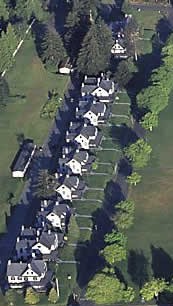
From the interview with Mrs. Marguerite “Mariwade” Mc Ilroy Douglas of Albuquerque, NM  conducted by Shelly Testerman Randall  by phone from the Fort Worden History Center on January 31, 2004.  Mrs. Douglas was the daughter of  U.S. Army  Warrant Officer Fred W. McIlroy, who came to Fort Worden as Quartermaster in 1934, and served here as Lt. Colonel McIlroy, Commanding Officer,  when the post closed in 1953. Here she describes what it was like to live on Non-Com Row  as a child:

“We lived in a duplex.  We had huge backyards with huge clotheslines.  We had an area behind the clotheslines that had fruit trees and swings…regular board swings that were built there for us… The families had gardens.  When you left the house, you would go to the gardens and the mule stables that were way back there.”

In response to a question about her father’s garden:

“My dad had a wonderful garden going all the time in the growing season…I’m sure my dad did it because it was economical, because my mother would can things.  We had a basement and there was one large area that was lined with shelves and mother canned every imaginable vegetable and fruit.  She also sold the fish that she and dad would catch.  They would get up about 2:00AM and go down and put their little boat in the water…then go out and fish for an hour or two.   Then they would come home and dad would get cleaned up and go to work…we’d have fresh fish for dinner.  Mother was a wonderful cook with the fish they caught and the vegetables they grew.  I’m sure the garden was strictly an economical thing.  Dad had potatoes, string beans, carrots, radishes…other things, all kinds of vegetables.

Posted in Military | Tagged , , | Comments Off on Interview With Marguerite “Mariwade” McIlroy Douglas

Interview With James Deen

From the interview with James Deen of Port Townsend, WA conducted by Mona Lou Stefflre at the Fort Worden History Center on May 15, 2003.  Mr. Deen served in the US Army at the early warning radar site atop Artillery Hill in Fort Worden from 1959 to 1961, when he was reassigned to Site 93 Nike Hercules in Kingston, WA for three years.  Here he describes an incident that occurred during his time in Kingston:

“Fort Worden was a dream, but you went from a dream to a nightmare there.  There was a battery commander, Captain J.F.C., who was just absolutely terrible.  Kingston was considered Stalag 93.  We were on a missile site and we had 24 hours on and 24 hours off, but you got a lot more on than off.  I was a buck sergeant.  One time, I was getting ready to leave shift in the morning and take my crew with me.  There had been a hail storm with a tremendous amount of hail.  The platoon leader, Lieutenant Butler let me know that before I could leave, the Captain had said that there was white stuff all over his lawn and we had to get rid of it.  So we got these big old street brooms and we were out sweeping the damn hail off the grass because this idiot didn’t want white stuff on his grass. That’s just an example of the kind of person we were dealing with there.”

Posted in Military | Tagged , , , , | Comments Off on Interview With James Deen

Interview With Robert J. Bussey

From the interview with Robert J. Bussey of Fridley, MN conducted by Shelly Testerman Randall  at the Fort Worden History Center on March 19, 2002.  Mr. Bussey  served in the US Army Corps of Engineers 369th EBSR from 1950 to 1952.  Here he describes his experience in Korea at the Punchbowl:

“I wound up in the 1343rd Engineer Combat Battalion, right up in the Punchbowl.  There wasn’t a lot of space left to go north from that point.  Primarily we did road and bridge construction.  One of our major projects was purified water, the water served anybody and everybody who wanted it.  We did a lot of mine field work, mostly clearing mine fields, and we dug gun emplacements for artillery.  It was basic engineer field work, which I didn’t realize how important it was until I saw something on TV about combat engineering—we were just doing our job.  It was noisy, there was artillery fire going on virtually day and night.  I was only a couple of thousand yards from the front line, the main line of resistance.  But nothing ever came our way, and wasn’t that particularly dangerous; though we did lose guys, mostly to clearing mine fields either stepping on something or when they pulled the mine.  We had one blow up and kill one guy and injure six other guys.  Otherwise, it wasn’t that dangerous. Well, you remember it.  You remember the noise, you remember the artillery fire.  Depending on the way the wind blew, you either heard a lot of noise or you heard no noise.  It looked like a typical Midwestern summer thunderstorm with the flashes of lightning .  (We were) a couple of thousand yards from the main line, which is not very far; but in a hilly part of the world like Korea, it was far enough to be safe because they couldn’t see you.  There was no point in shooting at us, and we weren’t shooting at them.  We were just engineers.”

Posted in Military | Tagged , , , , , , | Comments Off on Interview With Robert J. Bussey

Interview With Joan Best

From the interview with Joan Best of Port Hadlock, WA conducted at the Fort Worden History Center by Patience Rogge on July 15, 2008.  Ms. Best worked at the Fort Worden Juvenile Treatment Center as a teacher from 1965 to 1967.  Here she describes some of the students she encountered:

“One of the things I really liked about these kids is that many of them were fighters.  That is, they wouldn’t let the system get to them; and so, because they had resisted and not caved in, they were often sent here.  For example, there was a young Caucasian boy, sweet, nice, bright kid who had never been in any trouble.  He had been picked up because his mother had married a black man in Tacoma and the Tacoma system was so negative toward blacks that they sent him here as a dependent child rather than allow him to be raised in a family in a black neighborhood. At that time they put dependent as well as delinquent children in institutions.  That was kind of awful but he took it all in stride.  I’m sure he turned out okay because he was a very confident kid.  I had a girl  named Sandra (not her real name) in my class who was very bright and feisty, she was a black kid from the inner city in Seattle.  Most of the kids were from the city and had very little rural experience.  One of the things I began to realize was how little they understood about the natural environment.  I would take them down to the beach on a regular basis to help them see, and my instruction was to find something alive.  At first, they couldn’t; then I’d start turning over rocks and they would see crabs and they were scared of them.  They’d never seen anything like a crab.  These were kids who wouldn’t have been scared of stuff going on in the inner city, but out here it seemed dangerous, all this nature.  Sandra, however, had heard of sea monsters and she would not come down to the beach.  She’d stand up on the bluff and watch us.  She was pretty sure something was going to come out of that water and get us. I felt that for the kids who had come here, it was like they’d come to a foreign country.  It took about six weeks for them to figure out how to live in this new environment.  It had nothing to do with what their lives were like back in the city.  We (the staff) used to joke, we would place bets as to how long it would take a kid to turn around and come back because this was a safe place to be.  After they had become model citizens  (the Treatment Center officials) were supposed to send them back.  Sandra’s mother was a prostitute and we were supposed to send her back to be living with her prostitute mother.  Well, she was gone maybe a month or two and then she went into a gas station and stole something and just stood there waiting for the police to arrive so she could come back.  She was smart.  She knew where it was safe.  I remember one young boy.  There was betting going on about how long it would take him to return.  He got on the ferry going across to Seattle to go back home.  A staff person was taking him over.  He grabbed a woman’s purse on the ferry.  They just turned around and came back.”

Posted in Juvenile Diagnostic & Treatment Center | Tagged , , , | Comments Off on Interview With Joan Best

Interview With Robert J. Clouse

From the interview with Robert J. Clouse of Port Townsend, WA conducted by Hazel Hatfield at the Fort Worden History Center on March 6, 2003.  Mr. Clouse served in the U.S. Army 513th Missile Battalion at Fort Worden during the Cold War Era from 1956 to 1958  and later worked at the Juvenile Diagnostic and Treatment Center.  In this part of the interview, he describes his military service.  Mr. Clouse died in 2005.

“At that time there were two mine sweeps here in Fort Worden, the USS Redhead and the USS Elder, they were anchored at the dock.  There were about 80 sailors up on top of the hill called the Harbor Defense Unit, and there was a detachment of Marines over on Indian Island, also five to seven guys in the Air Force who were in the radio relay station up at the top of the hill.  The Army didn’t have a mess hall, so they gave us a subsistence pay of $77.10 and we ate downtown.  The Navy had liberty runs going downtown all the time and we just rode with them or would catch a ride with several of the guys who had vehicles. We were radar operators.  We ran a scope.  When we worked we were in a shack on top of Fort Worden.  We actually lived in the bunkers originally, then we were housed with the Navy.  The Army lived on one side of the house and the Navy was on the other side.  We lived in a huge house—there were two of them that were later torn down.  We worked two guys at a time, and we also had generator technicians because we ran huge generators. There were also three sergeants.  The total Army here then was 15 or 16.  We would rate for 24 hours and we would be on surveillance where you’re actually watching the scope for 16 hours. A Tipsy Dog Radar (AN/TPS I D) not only can pick the planes out of the sky, it can pick ships coming through the Straits.  That was the importance of the Tipsy Dog.  It is probably the same thing that the Air Force has out at Makah now.  The machinery was in the bunker, but upstairs all we had was an old generator shack and a little shack, because while you were on the scope your buddy was sleeping.  You took turns watching the scope.  You worked like a fireman—when you worked, you worked 24 hours straight through and then you were off for three days. “

Posted in Juvenile Diagnostic & Treatment Center, Military | Tagged , , , , , , | Comments Off on Interview With Robert J. Clouse

Interview With Dominic J. Caruso

From the interview with Dominic J. Caruso of Toccoa, GA conducted by Wendy Los by telephone from the Fort Worden History Center on June 15, 2004.  Mr. Caruso served in the U.S. Army from 1943 to 1952 as a radio operator.  He died in September 2005. Here he describes some events that occurred during World War II when he served in the Pacific Theater:

“In the Philippines we were stationed next to an ammunition depot and a Japanese airplane dropped a bomb there.  We lost four men that time.  We landed in Okinawa April 1st 1945.  We could stand on the beach and watch the Kamikaze planes hit the ship.  There were quite a few of those, quite a lot going on.  They were more interested in sinking the ships than they were with people on the beach.”

Describing his experience  in the Korean War:

“We started out in Pusan.  We went up to the north.  That’s when the North Koreans had pushed us back and back and back and back.  They were almost to Pusan where we started out.  Then we went up to Uijeonbu and numerous small villages, until we crossed the 38th parallel into North Korea and then we went into Pyonyang, then  to a town right up on the Yalu river where we could sit and during the day watch the Chinese across the river play volleyball.”

When asked about the Bronze Star he earned while serving in Korea:

“We were on a jeep and the jeep was hit by a landmine and I carried my buddies off into safety.  There were four of us in the jeep.  My buddy was injured but he wasn’t killed.”

About USO entertainment:

“I saw Bob Hope once in Hawaii, and I saw Grandpa Jones, he was a hillbilly country western singer. I saw him in World War II and I saw him in the Korean War.  (Louis Marshall Jones, 1913-1998)   Bob Hope had a bunch of entertainers, I saw all those people. Saw Mr. Hope in Korea also.  He came to Pyonyang, which was the North Korean capital, to entertain the troops that were occupying Pyonyang at that time.  We were on our way further north, we had stopped there for whatever reason the brass had and we stayed there about three weeks.  It was during those three weeks that Mr. Hope came and entertained.”

Posted in Military | Tagged , , , , , , , , , , , , , | Comments Off on Interview With Dominic J. Caruso

Interview With Walter Carroll

From the interview with Walter Carroll of Everett, WA conducted by phone by Carter Huth on May 11, 2004 from the Fort Worden History Center.  Mr. Carroll served in the US Air Force in World War II. As a student at Snohomish, WA High School, he was a member of the National Guard.  He came to Fort Worden for two weeks every summer for training.  Here he tells about firing the disappearing guns of Battery C:

“We stayed up on top of the hill in tents. We learned to use those disappearing guns.  They were five-inch guns, and they were about 20 feet long.  I used to heave shots.  This missile weighed about 100 pounds and I’d kick the missile and throw it into the breech and the powder would come in behind me.   They’d shove the big white powder bag that held probably 15 or 20 pounds of powder right in, then they’d slam the breech. They’d get their coordinates on the telephones and fire.  We used to fire at a target being towed by a tugboat out in the bay. By golly, we knocked them out of the water.  We competed with Battery A from Mount Vernon.  That was a lot of fun, I enjoyed that.”

Posted in Military | Tagged , | Comments Off on Interview With Walter Carroll

Interview With Robert J. “Buzz” Bosone

From the interview with Robert J. “Buzz” Bosone of Eastsound, WA conducted by Shelly Randall at  the Fort Worden History Center on July 11, 2002.  Mr. Bosone served in the US Army Signal Corps in Rome, Italy as a high speed radio operator in the Army of Occupation following World War II for one year.  Here he describes a dramatic rescue that he witnessed in the stormy Atlantic Ocean on his trip home on a C2 transport ship:

“During the afternoon, the seas became heavy and the ship took on some waves right over the bow, with the waves washing down the complete deck area.  The skipper had already had his crews string rope handlines along the deck areas when it was necessary for troops personnel from the ship to travel along the decks.  This helped to make sure they could do it safely.  However, the waves got bigger and the ship was pitching up and down like a bucking bronco.  The W(omens)A(rmy)C(orps) on board either didn’t hear the announcement or were already up on deck when it was made—because the skipper said for everyone to remain below deck.  All of a sudden, a huge wave hit, and that was when one of the WACs lost her grip on the ropes and was washed overboard.  The two remaining WACs quickly reported to the crew that one of their buddies had been washed overboard.   The skipper stopped the ship and announced her name and advised her to report to any crew member if she was still onboard the ship.  In the meantime, the rest of the troops onboard were taking a beating with the ship being hammered and rolled from side to side by the waves.  It was now dark and the crew manning the searchlights began scanning the sea to see if they could possibly see her on one of the distant waves.  Sure enough, the technique worked.  They saw her on top of one of those big waves. The skipper immediately launched one motorized lifeboat to try a rescue.  The rigging on that lifeboat was fouled and they had to cut the boat loose and sink it– sink the lifeboat to keep it from getting in the way of the rescue.  Another one was immediately launched and that lifeboat departed away from the ship to begin the search.  With searchlights from the ship and radio communications taking place with the lifeboat crew, they finally made contact and were able to lift her out of the water and into the lifeboat. It took two and one-half hours in the worse conditions you could imagine and they were finally successful in rescuing her.  Later, she said, when she found herself in the water and the ship’s lights going away from her, she took off her clothes and began swimming towards the lights.  She was a gutsy young lady, and also an excellent swimmer, to be able to stay afloat for two and one-half hours.  Her story made national headlines in the States.  Had this event occurred under battle conditions, they would not have risked the ship and the entire crew to save one life.”

Posted in Military | Tagged , , , , , , , , , | Comments Off on Interview With Robert J. “Buzz” Bosone

Interview With Edward M. Barcott

From the interview with Edward M. Barcott of Port Townsend conducted by Pam Clise at the Fort Worden History Center on January 28, 2003.  Mr. Barcott was a teacher at the Juvenile Diagnostic and Treatment Center from 1959 to 1971.  Here he shares his experiences as a beginning teacher:

“I came originally just to fill out a year’s contract.  One thing led to another and I just stayed.  The longer I stayed the more I liked it.  It was an interesting job, fascinating, with a lot of support.  The wonderful thing about this place was the staff and the support.  The teachers were involved with the social workers, the psychologists.  We had Cottage Committee meetings on every youngster every four to six weeks, and some of them a little sooner because the kid was more troubled.  It was an ideal situation because it was a learning experience all the time with a lot of good support.  When you first started, you started with locking yourself in a classroom with students, but you only had about a dozen of them.  The reason there was only a dozen was that they were either slow learners or non-learners and hostile.  They didn’t want to be there.  It was kind of scary, but after you got involved and learned the ropes a bit, it was workable.  They did an excellent job here, I think, better than most places by far.  I first had basically young men and I was in Evergreen Cottage.  My students were in an age group of 8th or 9th graders, but they were all behind, so they were all on the same page as far as what we did.  I just had a class that I worked with in social studies, English, math and reading.  I used comic books.  Some kid didn’t want to read, and I thought, ’Okay, how do you get them in a book?’ But they would read comic books, so I used comic books and it worked.”

In response to being asked how he learned to interact with the students:

“That’s where the Cottage Committee came in, which was critical.  They gave you insight into the youngster and the background.  I remember walking behind a kid (I was from a touchy family and always had a habit of touching kids) and I put my hand on his shoulder and he jumped.  I found out later he had been banged around a lot.  You were a little more cautious after that, you don’t touch unless they give you permission by a clue. The part of it  that was the hardest to learn, because you thought everyone was from a normal background and everything was okay.  When you learned where they came from and what they’d been through, it was amazing they were still able to function.  One of the most difficult things was that their self-image was way down low.  I remember walking with a kid from Eastern Washington down to the Ad Building, he was looking down at the ground, head down.  I said, ’Look up,’ and he said, ‘What for?’  I said, ‘Be proud of who you are!’  It took a long time for some of them to walk with their heads up.  The first few years we tried to send as many kids home as possible at Christmas time.  The kids would come back before Christmas Day.  They were safer here, they had a meal here.  They came back here rather than stay home.”

Posted in Juvenile Diagnostic & Treatment Center | Tagged , , , | Comments Off on Interview With Edward M. Barcott