
Interview With Michael Wierman

From the interview with Michael Wierman of Woodinville, WA conducted by phone from the Fort Worden History Center on September 18, 2012 by Eleanor Rigby. Mr. Wierman is a member of the Puget Sound Military Vehicle Collectors Club (PSMVCC), a group that has been holding an annual campout and show on Artillery Hill at Fort Worden for the past several years. The 2013 Military Vehicle Show is scheduled for the second weekend in September, and the public is invited to view the variety of vehicles on display.

Here Mr. Wierman discusses his vehicle, why he acquired it and its history:

“Mine’s a 1943 World War II Jeep. It was one of about 300,000 that were manufactured by the Ford Motor company. In World War II, two companies made the Jeep, Willys Overland and Ford, and they made about equal numbers. They’re the exact same design. They were using the same blueprints and all the parts were interchangeable. Unless you’re an owner, you probably wouldn’t notice the difference.

I was completely foolish. I’m a food machinery engineer and what I do for a living is a very humble profession, our focus is to make it easy for people to purchase and prepare their food so they have time to do other creative things. I always felt until I owned my Jeep that the military was kind of the opposite, that they destroy things. So, I wanted to kind of turn a sword into a plowshare concept, get an old military Jeep and have it and drive a food machinery engineer around. But during the time of restoring it, I completely changed. I met many a veteran and people involved in Jeeps. I decided that this was such an important part of history that I really needed to preserve it and do it right, and I’m glad I did. So, I’ve been still painstakingly making sure that this Jeep is absolutely spot on to the way they were back then. I’ve just had the best time meeting the veterans and the people who served in the military, and they are truly heroes. I couldn’t have stumbled across a better hobby.

Very few Jeep owners have any confirmation of what their Jeeps did because all the records were destroyed after the war. A few lucky ones may see a photograph of a Jeep that has a registration number available that could be tied to their Jeep but that’s almost one in a million. It is very unlikely.

My Jeep has a different story. There was a plaque on the dash when I brought it home that said it was remanufactured in 1945 by the Allison Sheet Metal Company in Arizona. I contacted them and they told me something about my Jeep. In that timeframe, during the Battle of the Bulge, a lot of equipment was damaged or destroyed. What we were doing was bringing those damaged vehicles back to the United States on those ships that would be empty or almost empty coming back. Then they would take them to wrecking yards where, if they could, make one Jeep out of ten; or trucks or whatever. Then they had them inspected and returned to service. Towards the end of the war, the inspectors did not come and all these thousands of vehicles were just left out in the parking areas. Then they were sold off as surplus to civilian buyers. The company did have records and that plaque basically told me that my Jeep was damaged in the Battle of the Bulge; also knowing the delivery date was in late 1943 helped.

Virtually all military equipment at that time was being sent over to England to prepare for the Normandy Invasion. So, my Jeep went over there and at some time it crossed into Europe and took a pretty serious hit on the left front tire. I can tell from the shrapnel damage, possibly from something like a landmine from below in the front. That’s what damaged it enough to where it was able to get back to the United States and be repaired. Then there is a blank in its history until about 1960, where I traced the owners back to a person who had done a lot of work on it and remembered my Jeep very well. He was hurt, he had a terrible accident in it and almost died. His friend restored it at that time. So, it has been restored many times and the last time by me. Of course I brag that it is the best restoration. That’s my Jeep’s story.”
Posted in Washington State Parks | Tagged , , , , , , , , , , , , , , , , , , , | Comments Off on Interview With Michael Wierman

Interview With Rosalie Lindquist

From the interview with Rosalie Lindquist of Port Townsend conducted by Eleanor Rigby at the Fort Worden History Center on July 14, 2005. Mrs. Lindquist is the widow of Elmer G. “Gus” Lindquist, the first superintendent of the Fort Worden Juvenile Diagnostic and Treatment Center. Here she recounts how they came to settle in Port Townsend:

“We were going to Carleton College in Northfield, MN at the same time and we both signed up for the crippled children’s camp and that’s where we really met. … We married in 1948. We moved to Lawrence, KS where Gus went to graduate school and lived there until he got his master’s. Then we moved to Topeka, KS where he was a social worker at the State Industrial School for Boys. We lived there for a number of years, then moved to St. Cloud, MN where he had a job with the Minnesota State Reformatory for Men doing social work.

We had some very good friends from the Industrial School who had moved out west. The husband called Gus and said, ‘Hey, they’re starting a new program. I think you’d be interested.’ So we moved to Chehalis, WA. At that time we had a daughter and a baby boy. Gus worked at Green Hill School for a while because the place at Fort Worden wasn’t ready yet. I remember driving up and looking at it. It was an abandoned fort, and I thought, oh they’ll never get this ready, they’ll never get this fixed up. But they did, took some years but they did.

We moved in in 1958, when the daughter we had in Chehalis was still a baby. They were madly getting the Commanding Officer’s House ready, that’s where we lived. They were still working on it as they were working on everything here. The business manager was the first one here and then gradually the staff kept arriving.

…There were a lot of old fashioned things (about the house). They redid the kitchen and put in new appliances. They did some redesigning of the place where the maids had prepared food and then there was a little butler’s pantry which was turned into a bathroom. They had an interior decorator from Seattle who came and was kind of in charge of all the things that were done, she planned and picked the drapes and things like that. The furniture was furnished.”

About living in Port Townsend;
“I was pretty much busy raising kids (the Lindquists had five children, three when they arrived and two while living at Fort Worden). There was an artist here in town at the time , Tom Wilson. He had a studio and there were a number of us who took art lessons from him, things like that, but I didn’t have much extra time.

…When we first came here I just felt like we had gotten home. It was a very different place than from now. The first time we came to town we stopped at a place for lunch, we walked in and sat down and the lady brought us a menu. We never saw her again, so we thought we’re not going to get anything to eat here, so we got up and left. It was a very small town and it was still suffering from having the Fort closed.

…We had a lot of friends (with the other staff and their families). At that time we bought our groceries (at) Sullivan’s Grocery Store, and so we also became acquainted with people that way. They had a son who was about our age and he introduced us to his friends, and it just kind of spread. So, we did have a lot of friends who were natives of Port Townsend and that part was good.”

Posted in Juvenile Diagnostic & Treatment Center | Tagged , , , , , , , , , , , , , , , , , , , | Comments Off on Interview With Rosalie Lindquist

Interview With Ruth Benson Short

From the interview with Ruth Benson Short of Port Townsend conducted by Wendy Los at the Fort Worden History Center on March 3, 2004. Mrs. Short, a longtime Port Townsend resident, served as a Gray Lady volunteer for the Red Cross at Fort Worden during World War II. Among the many stories she shared, Mrs. Short recalled some anecdotes about a friend:

“I just loved the colonel’s wife (Marguerite Wade Van Bibber McIlroy). She was a lot of fun. They were living in an apartment on Blaine Street and I was visiting with a group of women, we were knitting or doing something. There was a rap at the door and here stood a very darling couple and they’d just got married. Mrs. McIlroy went to the door, and the couple said they were making their formal call. She said,’You’ve made it. You don’t need to come in, just turn around, honey. When I was young and in love I didn’t want to be going to the colonel’s house to be talked to. You just go along.’

Then she came back in and she said, ‘A young couple like that just got married. They want to go home and be by themselves. Who wants to be up with a bunch of old colonels and all those kinds of people?” Of course, we just howled.

The McIlroy family moved from that apartment to a huge home on Morgan Hill. (In those days) when you had somebody come and knit and do things like we were doing, you always made sure that you picked all the cushions off your davenport and looked around and made sure that crumbs weren’t under there, that it was all clean–we all did that. One night, someone lost her knitting needle at Colonel McIlroy’s house. The woman who dropped the needle couldn’t find it, she looked and looked for the needle, then she went down in the cushions and said, ‘Oh, dear god! I don’t know what I’ve got a hold of!’

Then she brought it out and it was the biggest butcher knife that we’d ever seen in our lives. The blade was about like that (gesturing about a foot) and it had a big long wooden handle that said US Army on it. We all just roared. We said, ‘We know why we are paying our taxes because this shows the colonel is bringing home all the silverware and all the stuff from the Fort.’

Mrs. McIlroy said, ‘I can’t even imagine how that ever got in there.’”

Posted in Military | Tagged , , , , , , , , , , , , , | Comments Off on Interview With Ruth Benson Short

Interview With Russell C. Weber

From the interview with Russell C. Weber of Sequim, WA conducted by Oran De Bois at the Fort Worden History Center on June 1, 2004. Mr. Weber served in the U.S. Army from the time he enlisted in the National Guard in 1938 until he retired from the active Reserve in 1961. In World War II, he was a member of the 94th Field Artillery Brigade and the 4th Armored Division. He attained the rank of Major and received five battle stars and two unit citations. Here he described his time at Fort Worden:
“In 1938, I joined the Washington National Guard in Tacoma. In October 1940, we were federalized and sent to Fort Worden as an anti-aircraft unit, the 248th Coast Artillery. I stayed here until March 1942 and was sent to Officer Candidate School at Fort Sill, Oklahoma.
When we first moved here, we were in pyramid tents at the south end of the parade ground, right next to the bowling alley. We had a good time listening to the pins crash when we were trying to sleep. We were here all that winter in the pyramid tents and we were assigned to the three-inch anti-aircraft guns up on the hill. Our practice involved running up the hill to the guns and preparing and running through a program of testing.
In 1941 came Pearl Harbor. I was in Tacoma on vacation and immediately returned to the Fort. I was given a platoon of four men and put in a truck with tents and food and sent out to a place called Middle Point out on the coast where we were supposed to keep an eye out and watch closely for Japanese aircraft. Never did see any. About three weeks later we were relieved of that and brought back to the Fort. At that time, they had built the barracks on the hill, which we moved into.
The commanding officer of the Fort was Colonel James H. Cunningham. He was a very British gentleman who wanted very much to be a General. About once every three days, Colonel Cunningham would walk down the street, about 15 or 20 feet behind him were his two dogs, about 20 feet behind the dogs was his wife, and that was standard procedure.”

After Fort Worden:
“We were very busy training and being on the alert after Pearl Harbor.In March I left Fort Worden as a Sergeant and went to OCS at Fort Sill. After completion of the school, I became a Second Lieutenant and was assigned to Pine Camp, New York. I was with a field artillery unit, we stayed there about three months and went on maneuvers in Tennessee. From there we went to the desert in California, where we prepared to go fight Rommel in the African desert. About that time (May 1943) General Rommel decided to give up and leave Africa. So we had nothing to do but stick around California for another six months, at which time we were sent to Camp Bowie, Texas. We stayed there until December 1943 and were then sent to Boston to board ships and go to South Wales (in Great Britain).”

Posted in Military | Tagged , , , , , , , , , , , , , , , , | Comments Off on Interview With Russell C. Weber

Interview With Mary E. Hanke

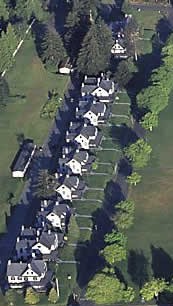
From the interview with Mary Elizabeth Hanke of Redmond, WA conducted by Cynthia Walker at the Fort Worden History Center on June 29,2002. Mrs. Hanke is the daughter of Lt. Col. George Frederick Newman (1911-1975) who was stationed at Fort Worden during World War II. The family lived in Quarters Nine West on Officers Row. Here she describes a bit of the social interaction at the post:

“There was a bowling alley. The commanding officer’s (Brigadier General James H. Cunningham) wife was an interesting woman who really took advantage of being the General’s wife, because whatever the General’s wife wanted to do, then all the other wives had to do. If she wanted to play bridge, they all got together and played bridge. If she wanted to bowl, they all had to bowl.

We (Mary Elizabeth and her younger brother) would get taken along to the bowling. It was in the summertime, and I will never forget, when she set a ball down to roll, it felt like it was going to be a week and a half before it got to the pins. It never went off course, it went where she was throwing, but it was just going ‘tu duh, tu duh, tu duh,’ all the way down the lane. My brother and I used to kid about it because we could tell when the General’s wife was bowling because there was this slow ball going down there.

She was a pretty good bowler. She just didn’t have any force to it. It’s amazing that it did knock anything down.

The Brigadier General was a short man, not very tall. My dad was six-four, weighed 220 pounds; and it wasn’t the happiest relationship between the two. I think he didn’t like it that my dad was so tall. I don’t know what else it could have been, but there were some interesting times between the two of them.”

When asked about other memories of the Fort, she responded:
“”The blimp hangar, actually the balloon hangar, because there were weather balloons, not actually something you could fly in. When they were gone, my dad and my brother liked to fly airplanes there. The kind that you would wrap, wind and wind rubber bands to get the power. They would fly them in there, there was all kinds of space for the planes to go way up and down and around. In certain kinds of weather, the hangar was so big that a little cloud would form inside the top. It had its own weather.” (The former balloon hangar is now McCurdy Pavilion, a performance venue.)

In response to questions about how the family dealt with wartime shortages, Mrs. Hanke replied:
“Rationing started right away, because of the mobilization for the troops, in fact, it increased. The further the war went, the tighter things got. We each had a ration book, and in each book were little stamps that could be torn out one at a time for different kinds of things. Shoes, coffee, tires,sugar, flour, eggs or butter. There was one that had a picture on it that looks kind of like a cornucopia, that may have been for fruit. I don’t know if we had to have it for fruit, but I do know we had to really take care of our shoes, and you alway got them resoled. You didn’t get to go get new shoes. That’s when they developed the kinds of non-leather materials to use for soles of shoes so that there would be enough leather to make the military’s shoes and boots.

Tires had to last, you had to make gasoline last. In fact it was so slim you really could not take any long trips or anything because there wasn’t enough to do that.

Mother (Margaret Cotton Newman) baked a lot, so the coupons that always disappeared first were the flour and the sugar. …I remember there were times when there wasn’t enough sugar, and to spill anything was just a crime, to waste anything. (Mother) saved balls of string, tied pieces of string one to the next so you got this big ball of string. We turned those in, they were used in some kind of manufacturing.

…That was when margarine came out to take the place of butter. It came to you white and there was a little envelope of coloring. If you preferred to have it yellowed, you had to mix it yourself to make your margarine yellow. It was called oleomargarine, It was hard work to stir that stuff into that thick margarine. My brother and I got the task of coloring the margarine,”

Posted in Military | Tagged , , , , , , , , , , , , , , , | Comments Off on Interview With Mary E. Hanke

Interview With Deb Johnson

From the interview with Deb Johnson of Port Townsend, WA conducted by Patience Rogge on October 28, 2004 at the Fort Worden History Center. Ms. Johnson was Dean of Jefferson Educational Services for Peninsula College. The Peninsula Community College District serves Jefferson and Clallam Counties on Washington’s Olympic Peninsula.  Its main campus is in Port Angeles.  At the time of the interview, the college had recently moved its Jefferson County site to the former Schoolhouse Building on the Fort Worden campus. Here she traces the development of the Jefferson County site:

“Peninsula College in the past ten years has grown significantly, and as we started to grow, we realized that we needed an alternative site in Jefferson County,i.e. Port Townsend as it turned out.  We moved from one end of Water Street to the other, and we stayed in the Waterman Katz Building on Water Street for six years.  We outgrew that place immediately, so we started a couple of years ago looking around at other places.  I always had Fort Worden in my head, as did Wally Sigmar, our since deceased president.  When they looked at it originally, to bring the building up to code and the infrastructure and the wiring for all the computers was going to be cost prohibitive.  But during the past six years the computers have taken a different turn, we were able to move into the building as of last week.

When we started, we had about 70 or 72 Full Time Equivalent students, I believe it was, and that was in 1995.  Right now we’re up to 150 FTEs, so we/ve just about doubled. The first seven years in this position, I saw a ten per cent increase every year, we’ve since leveled off.  We’re expecting now that we’re at Fort Worden we’re going to see another jump in our enrollment. With some of the new programs that we’re talking about adding in the next one or two years, we expect more enrollment.”

Talking about how it feels to be in the new facility, which was the post hospital during the Fort’s military era and became the schoolhouse when it was the state juvenile corrections facility:

“People are so excited.  They’re walking into this building, and even with boxes and tables still waiting to be unpacked, the students are excited, the faculty is excited.  We have space, we have windows, we have materials and chalkboards, white boards, everything we need.  It’s a whole new feeling of excitement and positive energy.

(Even though the building wasn’t built to be an educational facility) We’re actually making it work.  The classrooms, the big ones and the smaller ones, are workable. The funniest thing that we came across when we were trying to put something in storage in the basement last week was the old morgue.  The work study students got a big kick out of that, but nobody wanted to lie on the table. (On being informed that the top floor was the psycho ward) Hopefully that won’t come in handy for us.”


Posted in Washington State Parks | Tagged , , , , , , , , , , | Comments Off on Interview With Deb Johnson

Interview with Karl Dehmer

From the interview with Karl Dehmer of Sammamish, WA conducted at the Fort Worden HistoryCenter on July, 13, 2002 by Cynthia Walker. Mr. Dehmer spent his early childhood at Fort Worden, where his father was employed at the Juvenile Diagnostic and Treatment Center. His family, which included seven children, lived in Quarters 4 East on Officers Row. Here he recounts some memories:

(His parents had warned him to stay away from the older kids at the Center) “I would sneak over to the canteen in the back that sold ice cream bars and some candy. …I remember trying to sneak over in my older years when I was here, probably around five, six, or seven, sneak to the canteen to get an ice cream bar. That was a tough thing to do because you got a big wide open field, so you couldn’t walk straight to it. You had to kind of go along the edge or go down to the beach and then come up the side. I had a sweet tooth and I still do, so that was an adventure.

…Going down to the beach, there were no stairs when we lived here. So instead you would kind of have to navigate this big cable that was standing on its own because the hillside had eroded some, and you worked down the path, going all the way down. It was always neat because the ants walked across that cable.

…I remember the beaches. You found a lot more things, you found a lot more sand glass, more interesting rocks, because now there are so many people here. But before no one ever came through there. I remember at low tide I even found a double ax head and I thought that was totally cool. Up in the hill where the sand cliffs are, I remember going up there and finding some trails that weren’t from people, they were from animals traveling along there. I remember finding a deer antler. There were some neat things to discover, versus now it’s pretty well cleaned out.

…The bunkers were from my perspective very interesting but very scary, because I don’t know how stories got into my head, but as a kid you either make them up or you think about (things). We thought some monsters live in there and stuff. I remember going into the lower bunkers, but I never went up on the hill bunkers because that was too wooded and too isolated. I remember hearing stories from my brothers about the open doors that led to caves and they were off limits that you shouldn’t go into. So we’d go to the lower ones and play on those, but the upper ones I never touched because I just wasn’t ready for those. I remember also the obstacle course in the back woods,there’s still a little remnant of part of it. …I also remember my brothers working back in that area where they were digging up old bottles. I think there were some antique bottles that I’m sure are either buried or gone now.

(I mostly played on the beach or under the pier) You’d hang from those bars under the pier and they’d swing down and you’d walk out on them to look into the water and things like that. I wasn’t at the age where I was gutsy enough to jump into the water, and it was still pretty cold.”

Posted in Juvenile Diagnostic & Treatment Center | Tagged , , , , , , , | Comments Off on Interview with Karl Dehmer

Interview with Gerrit Nieuwsma

From the interview with Gerrit Nieuwsma of Hague, ND conducted by phone on June 30, 2005 by Eleanor Rigby from the Fort Worden History Center. Mr. Nieuwsma served in the US Army at Fort Worden from 1951 to 1953. Here he relates some of his experiences:

“We got there in the end of February, the first week of March we got a foot of snow. They said it was unusual,’You never get snow out here.’ We marched around in the snow and your boots would get soaked. It was about 30 above. It lasted just about two weeks it seemed. Then the next day you’d put your dry boots on again. But then a lot of the men got pneumonia and the chow line looked like it was bloody from the people who spit their blood out. Some of us didn’t have sweaters and some didn’t have field jackets, we didn’t have so much stuff at first.

…They were going to train us for the LCM landing in North Korea…Those are the most miserable things there are in the world to ride. …I was in about four or five months and they asked for butchers one day, so I volunteered for butcher.

They said,’Well, you know where you’re going to go?’ I said I didn’t. They said, ’They’re going to send you to the morgue.’ I said I didn’t care, ‘Anything is better than those boats.’

They sent me to the butcher shop and then after about two months I got transferred into 6008 Post Operating Company and all we did was cut meat for the troops.

…The butcher shop was a good place. …In the morning, when we’d come in we had a coffee pot that was hid and we had a hot plate. We had civilian friends who worked in the warehouse and they stocked food and stuff. They would come in and have a hamburger and they would give us coffee in exchange. Before we went to work everyone usually had coffee, and no other place on camp could do that.
…(There was) one pretty interesting fellow who lived in Port Townsend, he was Lieutenant Colonel Fred W. McIlroy. In the morning before anybody got up, at five o’clock, he’d be running around the parade ground. For physical training he would take us and run us around the parade ground for three quarters of an hour without stopping. One day he was showing this one company and he said, ‘You can’t even make an about face.’ The poor fellow was going to make an about face and he fell flat on his face, and that was the end of that.

He was 69 years old and drove a little MG. The reason I got to know him pretty good (was that) he’d come to the butcher shop. We’d cut T-bone steaks or something like that and get a lot of meat shavings. He’d get them (the shavings) for his dog. “

Posted in Military | Tagged , , , , , , , | Comments Off on Interview with Gerrit Nieuwsma

Interview With John W. Singhose

From the interview with John W. Singhose of Port Angeles, WA conducted by Rick Martinez on May 10, 2002 at the Fort Worden History Center. Mr. Singhose served in the 369th Boat and Shore Regiment, later called the Engineer Amphibious Support Regiment, at Fort Worden during the Korean War era. He was Staff Sergeant Singhose when he led his squad at the Fort. Here he recalls his early Army days:
“I joined the 369th very shortly after entering the Army. We were sent to Fort Lewis, WA for processing and whatever and to get our gear, clothing and all that. We were scheduled to get on a train and go to Fort Riley, KS for infantry training. They needed infantry in Korea real badly. They were real shot of infantry in Korea.
In the meantime, there was a flash flood in Montana and part of a railroad bridge had washed out and was damaged, so they couldn’t run trains over it. So they held us up for a few days. In the meantime, the 369th EBSR was activated and they had some reservists who were training here at Fort Worden and they were looking for some people. So they sent a little over a hundred of us over here to fill those ranks. We took our boot camp right here.
(Fort Worden) was a classic small Army post. We didn’t even have a guard on the gate. People came and went on their own, there was no check in, no check out. I had the same car I had before I was drafted. They gave you a little oval deal to put on your license plate, it was reflectorizd. My number was 207. After we did get a guard on the gate, the MPs would look at your little red deal and,’Hey, come on through folks, you must be okay.’
We had a wonderful firing range over at Cape George (on Discovery Bay). There were no homes there at that time. There had been an old sawmill there, and kind of like a little logging camp. There were still a few old cabins around. …I think that maybe it might have been the Second ESB that had gone down there and built some berms and stuff there, it was a pretty goood facility. Only thing of it was that the wind came right off the water, right to where we were firing there.
Captain Gibbs was our company commander at that time. It was cold and we were trying to fire and our hands were numb, regular combat conditions. He said, ‘Why don’t you fellows build some fires?’ In those days everybody carried a jack knife. We whittled some shavings and got some fires going. That was the best thing that could have happened to us. Very considerate person, Captain Gibbs.”
When asked if the troops had the standard targets with the big target cloth frames that were lifted, Mr. Singhose replied:
“We had people down there at the butts. They raised and lowered those. If you missed the target completely, they had a red flag called Maggie’s drawers that they waved back and forth. …I also remember if there was a boat that came in kind of close to shore, we had to stop firing. The bullets would go off the bluff into the water. There wasn’t much shipping in those days, but we had a fellow on either side of the range, it was their job to see if there was anybody coming. We were equipped with binoculars and all that.”

Posted in Military | Tagged , , , , , , , , , , , , , | Comments Off on Interview With John W. Singhose

Interview With Virginia H. Walter

From the interview with Virginia Hartman Walter conducted at the Fort Worden History Center on October 16, 2002 by Rick Martinez. Ms. Walter was the daughter of Major Hartman of the Coast Artillery stationed at Fort Worden in the late 1930’s. The family’s quarters were an apartment in Building 16 on Officers Row. Here she discusses life as an Army brat:
“Dad had been stationed in Panama and then was sent here…My mother, sister and I came from Panama to be here in September because it was my last year in high school and Mother didn’t want me to miss any school. Dad arrived just a few months later and we moved out to the base from town. We had been assigned quarters since Dad came. Mother didn’t want to live in the big houses like we’d always been living in, and they requested an apartment in the brick building right across from the tennis courts, right next door to the Bachelor Officers Quarters, which was very convenient.
(Making new friends in a new school)was no problem. I loved it. They accepted me and I joined them, but I still liked being around the military. I love traveling and meeting new people, and then the thing about it, you usually run into them all through your life somewhere. (Being in new situations all the time helps you to) handle things because you’re used to having to.
There was a bus available to take us to school, but I got to ride in a convertible most of the time, being next door to the BOQ. I was only at Port Townsend High that one year, then I went to the University of Washington.”
When asked about life at Fort Worden compared to other posts:
“Anything seemed good, because we’d been stationed in Panama before and we didn’t like it there. I figured I’d wasted two years of my life there, because we were in Fort Sherman on the Atlantic side and you had to be ferried across to Fort De Lesseps to take the bus there to go to Christobal High School. The CO cut the ferries off at six o’clock, so the morale was pretty bad at Fort Sherman. The soldiers didn’t like that. They wanted to go over to Colon to the cabarets and everything. But I had a real good friend who lived in Colon. Her father was the captain of the ferry; and so, when any school activities were going on I could stay with them.
It was so good to get away from Panama. Nine months of rain out of the year. I didn’t even notice the rain here.”

Posted in Military | Tagged , , , , , , , , , , , , , , | Comments Off on Interview With Virginia H. Walter