
Interview With William F. Gurley

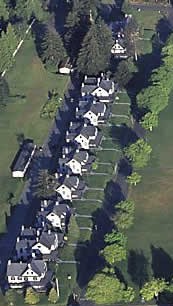
From the interview with William F. Gurley of Kingston, WA conducted by Ken Brink at the Fort Worden History Center on July 2, 2002. Mr. Gurley’s father, Captain Franklin Chris Gurley of the U.S. Army Coast Artillery Corps, commanded A Battery at Fort Worden from 1937 to 1940. The Gurley family lived on Officers Row in Quarters Six West during their time at Fort Worden. Here Mr. Gurley talks about what it was like to be living on the post in the years before World War II:
“It was a hell of a fine place to be a kid. We had the parade ground to play football on, had the gym to play basketball in, everything was here. In those days, of course, if you had five guys to play football with, two on one side and three on the other. We didn’t have uniforms and that kind of stuff. We just played ball to have fun.
…There was no guard at the gate or anything like that. Anybody who wanted to come on post, came on post… The only time there were any restrictions was when they were having a service practice and firing the weapons, then you couldn’t go up on the hill. (That didn’t happen very often because) they didn’t have enough money to shoot it very often back before the war.
…We were just kids like everyone else (in town)…If somebody saw you misbehaving, it was a pretty small town and it didn’t take long for it to get back to your folks; so, if the person who saw you didn’t straighten you out very shortly, when you got home your father would.”
Describing his father’s job at Fort Worden commanding A Battery:
“It was full time, leading these people, having them and seeing that they were trained properly on the weapons they had to use up on Artillery Hill. Oh, all the military courtesy, and the marching and the drilling, and all of that business. He had to oversee that and make sure it happened. Of course, let’s face it, the first sergeant did most of the actual doing; but the officer was responsible.”
When asked about memorable characters:
“Colonel and Mrs. Pace; the commanding officer, Colonel Cunningham. Charlie Meyers, Major Meyers. Chuck Meyers was his son. Chuck was going to go to the Military Academy, but a bunch of us were up on Artillery Hill one day and we were climbing down that real steep escarpment that you can see from the lighthouse. Chuck slipped, fell all the way down to the beach and dislocated his hip, fractured his leg. We got him out of there, but that was the end of his hopes for the Military Academy. He had one leg that was shorter than the other after that. I don’t know what happened to him. I don’t know what he did.”
Posted in Military | Tagged , , , , , , , , , , , , , , , | Comments Off on Interview With William F. Gurley

Interview With Harold P. Aden

From the interview with Harold P. Aden of West St. Paul, MN conducted by phone from the Fort Worden History Center on November 4, 2004 by John Clise. Mr. Aden served in the US Army 369th Engineers as a truck driver in the motor pool during the Korean War. Most of his time was spent at Fort Flagler on Marrowstone Island and at Camp Desert Rock, NV. Here he discusses his time in the Army:

“We stayed on Fort Flagler on the island. We got there in about March 1951, we stayed there til about November of 1951. Then we went down to Camp Desert Rock in Nevada where they had the bomb testing sites. We stayed down there til June of ’52, then they shipped us back to Fort Flagler and we stayed there the rest of my two years in the service. …We did go down to Coronado in San Diego for a month, maneuvers, before we got out of the service. …At one time we did take a bunch of men down to Yakima, Washington, for a machine gun range they had down there. I didn’t participate in the machine gun firing or anything. I just drove the truck down there and then we just kind of goofed off all day for two weeks. I had it pretty easy in the motor pool.

…I think the only stress we had was the morning we were in Camp Desert Rock in the foxhole waiting for the atomic bomb to go off. It was kind of scary. We didn’t (have any special glasses), we just kept our heads down in the foxhole. I forget how it was, but first you hear the noise and then you feel the shock and then the lights. It was quite a spectacular thing.

We were down there putting up Butler buildings and so forth because we were in the Engineers. About every month they would ship in a bunch of new service people to watch these atomic bombs.

At Fort Flagler, I just kind of went up to the motor pool and I think we were always done at 3:30 or 4:000 in the afternoon and then we’d go back to the barracks and have our chow. We had our movie theater there and the beer hall, of course. There was a USO Club across the parade ground. Occasionally we went on pass. We’d go to Port Townsend, and if we got a three day pass we might go to Port Angeles. One time we went up to Vancouver, Canada….Our main way of getting over to Port Townsend and back was riding the M-boats.”

Posted in Military | Tagged , , , , , , , , , , , , , , , | Comments Off on Interview With Harold P. Aden

Interview With Lucinda Hall

From the interview with Lucinda Hall of Tacoma, WA conducted by phone from the Fort Worden History Center on March 15, 2005 by John Croghan.  Ms. Hall’s father was a cook at the Juvenile Diagnostic and Treatment Center, her family moved to Fort Worden in 1969 and left three years later when the Center closed.  Here she relates some childhood misadventures:

“We used to go down to the hangar (now McCurdy Pavilion) and play on the Rhododendron Festival floats that were stored there….The bunkers were our play house, we used to sleep in there and play, yeah, we had good times. We used to go up on Artillery Hill above the barracks that we lived in.  I remember the time the woods behind our house caught on fire.  Kids were playing with matches.  The fire truck had to come out.

…The road from Artillery Hill came down and around to the barracks.  There were a couple of us who got hurt on that road. I was riding my bike down that very steep hill and a stick got caught in my spokes. I went flying down the hill. I had head injuries.  My brother was with me. A lady who lived in the houses over there came over to help and took me home.  My parents were gone, my older brother was the only one who was home. My younger brother thought I was dead there was so much blood.

…Then there was a pole right by the building there.  We used to use that hill to slide down on inner tubes when it snowed.  The kid next door hit the pole and broke his leg.”

Posted in Juvenile Diagnostic & Treatment Center | Tagged , , , , , , , , , , | Comments Off on Interview With Lucinda Hall

Interview with Gasper J. “Gus” Impiccini

From the interview with Gasper J. “Gus” Impiccini of Clarksville, PA conducted by Rick Martinez by phone from the Fort Worden History Center on November 16,2004. Mr. Impiccini served in the US Army Co.D 532 EBSR 2nd Engineer Special Brigade, from 1949 to 1952. He was stationed at Fort Worden from June 1949 to July 1950. He took part in the Inchon Landing in September 1950, and served in Korea for 14 months in total. Here he discusses his experiences:

“The landing was tough on me because they started hitting that beach about two o’clock in the morning, says full pack and rifles, you’re going to shore. I was scared. I didn’t remember what to do, couldn’t run. All of our LST equipment was on there, we could see it sitting in the mud on shore. We set up the beach head there and started bringing troops and equipment.

…I have some shrapnel in my chest from North Korea but it wasn’t major or anything. …I do not know how I survived. We weren’t equipped for that conflict. We didn’t have great shoes with insulated boots. We were over there with those engineer boots and that’s it. And our clothes, had no clothes at all to keep us warm….A few guys were killed in our outfit. It wasn’t nice, you know.

…When I first got to Fort Worden I thought it was the end of the world because there’s a lot of rednecks up there. I wasn’t used to that kind of people. To tell the truth, they were all good guys after I got to know them all. They looked after me good. A lot were World War II veterans, and that’s why I’m still here today, because they were in combat before and they knew all the angles.

…When we were in North Korea, when we made the big push up there in Hungnam, they brought us in a Merchant Marine ship with supplies. They went on strike. It was kind of discouraging to all of us. We went on board and unloaded it. Some of the other guys from Company D would know too, because we were up there in winches and unloaded their ship. We had guys stationed there with loaded rifles in case those Merchant Marines had any problem with our guys working the winches unloading that cargo. It’s sad, wartime and then they went on strike and they wouldn’t unload the ship.”

Posted in Military | Tagged , , , , , , , , , , , , , , | Comments Off on Interview with Gasper J. “Gus” Impiccini

Interview With Wilfred E. Allen

From the interview with Wilfred E. Allen of Sagle, ID conducted by phone by Wendy Los from the Fort Worden History Center on February 22, 2005. Mr. Allen was assigned to Fort Worden from June to September 1952 as Sergeant of the guard, after he returned from four years in Germany with the 507th Engineers. Here he recounts some of his experiences in Germany:

“I was running a welding shop and a rebuild shop, rebuilding heavy equipment in Hanau. I was told to meet an officer at the flagpole. When you came in the main engineer depot there was a big flagpole that you drove around. I was to go up there and report to him and not tell anybody where I was going. I got up there and he showed me a lid that had broken hinges and asked if I could weld it. I said yes, so he said, ‘You go back and get your stuff and come by yourself and weld that. I’ll tell you now that all the explosives to blow up this depot are underneath that lid. Can you still weld it?’

I said yes, so I welded it and that was the end. Nobody knew about it but me and the officer.

Later on the company moved on to Kaiserslautern and ten of us stayed behind. Our job was to blow up the depot in case the Russians should happen to attack. They were only 30 miles away. We’d go down at night and practice. The practice explosives were wooden blocks, we’d put them on the equipment in the same spot on each equipment, like under the starter on each dozer. Then we’d wire it up with string. It was just imitation, supposed to be explosives. Then we’d call the officer to blow the depot. If they told us to, I was to go back to my shop and open up all the oxygen-acetylene bottles and roll them down the middle of the floor. If I survived the explosion, and if I could find anything that would start, I could start it and run. But it never came to that. The Russians never did come.

…There were five of us who went to Amsterdam and rented a 1950 Chevrolet and headed for Rotterdam. The deal was that you paid by the mile. A couple of the boys were mechanics, one of them went under the dash and unhooked the speedometer. We drove it most of the day, and on the way back to Amsterdam the mechanic hooked it back up. We drove into the shop, and I just knew we were going to be put in jail. They never noticed and just charged us for the mileage on the speedometer.

…I was in Germany. I went up to the Swiss border but they wouldn’t let me across because I didn’t have permission to take my uniform in. So I walked up to the chain and I put my foot over on the other side. The guard kind of grinned at me. I can say I was in Switzerland.”

When he returned to the United States:

“When my orders came out I went to Fort Worden with the port construction engineers. They didn’t have a welding shop there, so they sent me out on a rifle range and every day the sergeant would ask me what I was going to do. I said I didn’t know. He said,’Why don’t you ride on that grader or ride on the dozer and get some experience. When you reenlist it will do you some good.’

I didn’t tell him I was not going to reenlist, he’d probably have had me peeling potatoes.”

Posted in Military | Tagged , , , , , , , , , , , , , , , , | Comments Off on Interview With Wilfred E. Allen

Interview with Robert S. Adams

From the interview with Robert S. Adams conducted by Henry West at the Fort Worden History Center on July 9, 2002. Mr. Adams’ father was a sergeant in the 14th Coast Artillery stationed at Fort Worden at variuos times during his career, which spanned the years from the 1920’s to the 1940’s. Here Mr. Adams recalls memories of his childhood at Fort Worden:

“I was allowed to go watch my dad’s battery, G Battery. The 14th Coast Artillery at that time had A Battery, D Battery, G Battery and Headquarters, plus the Quartermaster which was part of Headquarters. If I didn’t have school the next day, or on a Friday night, and they were going to fire guns (they fired them at night for practice) my dad would allow me to go to a certain area, but I couldn’t go outside that area. Because if I went outside that area, I got a Sam Browne belt across my backside.

…I was allowed more times to go see them fire Battery Kenzie than anything else, although I did see them fire Tooles. Once or twice I got to go up and watch them fire the mortars. All the batteries had to be proficient in all the guns. (They interchanged the training because) in a wartime situation, if a battery lost some men certain people from another battery would have to go in and they would fit right in.”

About the guns:

“…It was 1900 steel, it isn’t the steel that we have today. My dad told me that when they fired rapid fire, which was two shots within 35 seconds of one another out of the twelve-inch gun at Kinzie, that gun had to sit there and cool off for four minutes. The steel just couldn’t stand the heat and the barrel would have a tendency to bend. The barbettes, the guns on the fixed mounts, were from the same steel. I don’t think it was until World War I that they started getting steel that they could fire faster, longer.”

About the searchlights, night firing and targets:

“The searchlights were normally connected with observation posts. I will brag about the 14th Coast Artillery because those guys were good. They could get an azimuth on where the target was and the range, they could hit that range within about 15 yards. They called that in to the plotting room where everything came together. Thirty seconds later, that gun was firing. They say at 10 miles, the distance was a half mile that target would travel. It was like shooting ducks, you had to lead or you missed.

They used a tugboat that they called the L35 and they also had a mine planter, the Bell, to tow targets. …The target was about 100 yards behind the towboat.

I do remember Dad’s battery once firing a six-inch gun up on the hill. I think it was the Bell (towing the target). When they got to the end of their run, the target wasn’t there anymore. They radioed out to the Bell to put out another target, because they had some more rounds they wanted to shoot. The Bell came back and said, ‘Can’t do it, you broke every damn cable we got.’ So that ended the shooting for the night.”

A story about General James H. Cunningham:

“When Jimmy first came on the base as a bird colonel and the commanding officer, he started issuing orders. He was going to make this place G.I. Of course, the orders came down through the chain of command. By that time, my dad was a first sergeant in G Battery and the company commander said, ‘Sergeant, put these into effect.’ My dad would go in and read the orders. He wasn’t one who liked to use four-letter words, but I guess he used them.

Dad and I were walking back from lunch one day, I was going down to the beach to play, and along came Jimmy with his two black dogs. My dad saluted him and stopped in front of him. The general saluted back. My dad looked at him and said, ‘Sir, may I make a recommendation?’ The conversation went something like this: The General, ‘Yes, Sergeant, I take all recommendations under advisement.’ My dad, ‘Fine. You run the Officers Club, let the non-coms run the Army.’

He got away with it. It wasn’t a court martial offense.”


Posted in Military | Tagged , , , , , , , , , , , , , , , , , | Comments Off on Interview with Robert S. Adams

Interview With Don Willott

From the interview with Don Willott of Bainbridge Island, WA conducted by Wendy Los at the Fort Worden History Center on March 23, 2004. Mr. Willott worked at the Fort Worden Juvenile Treatment Center from September 1967 to June 1968 for his second year placement as a graduate student in social work from the University of Washington. Here he describes what his work involved:

“It was called a practicum. You had your book learning, the classes at the university and for two days a week you were actually doing a job similar to what employees were doing, but under supervision because you were starting out.

…I hadn’t been to Port Townsend or Fort Worden that I could remember. When a female student and I drove up, we pulled into a gas station up on the outside of town and asked if we were in Port Townsend yet. They told us no, but if we went down the hill we’d find it. I saw there was a real town, a pretty old and historic town, and then we found the Fort.

… It was fun, because we stayed in the Commanding Officer’s Quarters, folks called it the Red House. We’d stay overnight there, and there was a housekeeper who kept the place up. There were other people who visited, like people from other institutions who needed to come. It was used as a guest area.

…I knew no one when I got here as a student. We had a field instructor who was our supervisor, Bob Warfield. Later on, I worked at Western State Hospital and he also worked there. There was a system of treatment centers across the state, this was one of a group in different places. They tended to be divided by how severe, how delinquent the behavior had been, and by age. Fort Worden tended to have junior high age kids. Echo Glen had younger kids, Green Hill School had older kids. There were forest camps that all had junior high or older kids. (My job) was like counseling. They were kids who had been in some trouble and they were committed here by a juvenile court and had gone through Cascadia Diagnostic Center in Tacoma. The nature of the program here was a treatment program by contrast with the current program which is more a correctional program. People think of it much more like juvenile jail. I think the kids who were here appreciated it, but obviously it was a mixed kind of thing, they missed being home and what not. I think the average stay would probably be under a year. It was not a sentencing, the court didn’t say how long, the staff here decided how long.”

Posted in Juvenile Diagnostic & Treatment Center | Tagged , , , , , , , , , , , , , , , , | Comments Off on Interview With Don Willott

Interview With Barbara B. Wickert

From the interview with Barbara Boyd Wickert of Pflugerville,TX conducted by phone on December 16, 2008 from the Fort Worden History Center by Eleanor Rigby. Ms. Wickert, the daughter of Colonel Joseph Lyon Boyd, was born at Fort Worden. Here she relates the story of her birth:

“I was born in the quarters. My mother didn’t make it to the hospital. The story I grew up hearing was that my parents lived in a three story complex with apartments and that the stairs on the upper level went past the kitchen window. My parents lived on the second floor. My mother,quite pregnant, was standing at the kitchen sink washing dishes when the neighbors went down the stairs to go to the movies–everybody walked everywhere because things were close together. When the neighbors came back up the stairs after the movie, they looked in the kitchen window again. The baby was born and was being washed at the kitchen table.

I was not ever back there after my infancy, I don’t have any memories of living there. It was mostly the stories I heard told as I was growing up. However, the doctor, Dr. Ison, who brought me and my brother into the world was at Fort Worden too. My parents must have lived there for at least three years.

About her family:

“My older brother, Joe, junior was also born at Fort Worden two years before me. My father served in the Medical Corps, he wore the caduceus insignia on his uniform. He was the post dentist at Fort Worden. He went into the service right out of dental school right before World War I, so he served in both world wars. During World War II, he had quite a large group of dentists serving under him. He was a full Colonel.

His first station was in Manila before the First World War. He had met my mother while he was still in college going door to door selling WearEver aluminum cookware. She was a schoolteacher in a town in Texas when he courted her. From Manila he wrote her a letter of proposal and said that if she would accept, he could get leave to come back to the states and they could be married. Their trip back to the Philippines would be their honeymoon. It took a whole month on the transport to come from San Francisco to Manila. The doctor who delivered me was stationed there and that’s when my parents first got acquainted with the Isons who were friends all their lives.

When I was seven years old, we went to the Philippines and lived on Corregidor Island….I was ten when we came back from there. By then our family had four children.”

Posted in Military | Tagged , , , , , , , , , , , , , | Comments Off on Interview With Barbara B. Wickert

Interview With Naomi Wood

From the interview with Naomi Wood of Bellevue, WA conducted by phone from the Fort Worden History Center on June 10. 2004 by John Clise. Mrs. Wood, the widow of Captain Richard H. Wood of the US Army 369th Boat and Shore Regiment, lived at Fort Worden in 1950/51 with her husband and two children. Here she talks about life on the post:

“At first they put us in a house high up (on Artillery Hill). We had a beautiful view. In about three or four months, we moved down to Officers Row. We loved the whole thing. It was like being in Shangri-La.

It was easy living and lots and lots of good friends. There was always something going on. I’m a bridge player and we had that, and then we had the Officers Club where we had lots of neat parties, and just traded dinners back and forth. We just loved the area, it was so beautiful.

The kids had the greatest time because they were on Officers Row. There is a hill behind it and the little boys played Indians up on that hill, they had a great time together. In the evenings when they were closing down, during Retreat, playing Taps on the parade ground, all the little boys would go out in front of the houses and stand at attention. I can’t think of any special rules, of course we had to keep our children under control and eight o’clock was the go to bed time. We were all good friends on the Row, and we knew some of the non-commissioned people too. We’d have picnics, it seemed like we were always having a good time.

At the end of the next October, they started sending the fellows out to Korea or Japan. We had to start moving out and figure where to go. We decided that the children and I would try to find a place to live in Salem, OR. It was on Halloween night that were driving down for the last time from Fort Worden.”

Mrs. Wood added a bit of interesting history:

“The Boat and Shore Regiment got up there (to Fort Worden) and had to start from scratch. Colonel George Spaur was the commanding officer, he was the head of the Department of Forestry in Oregon. The officers who had been there for awhile kind of found out in a secret way that the whole regiment had been called up by mistake. None of them were ever used to any boat and shore stuff, so they had to learn all about that.”

Posted in Military | Tagged , , , , , , , , , , , , , , , , , , , , , | Comments Off on Interview With Naomi Wood

Interview With Michael W. Downey

From the interview with Michael W. Downey of Redmond, WA conducted by phone by Henry West from the Fort Worden History Center on October 19, 2004. Mr. Downey served in the Youth Conservation Corps group that worked out of Fort Worden in 1976. Here he describes the work and life:

“I just applied for it (the program). It was sought as summer work. My dad worked for the state at the time in Olympia and he brought home an ad for it and I applied. I believe that the kids were selected by lottery. We were paid by the state, and the program was three months long. (At Fort Worden) we lived in an old barracks building right at the base of Artillery Hill.

We did a lot of work in those three months. …the purpose of the program was to enhance the various state parks around the region. There would be different groups of us that would go to the different places…We built trails and then fixed up the campsites, things like that as far as landscaping. Then we were transported and stayed at various locations throughout the state doing the same thing to their parks. We’d be moved around in vans and stay at various cabins, like Forest Service cabins or youth group cabins like the Girl Scouts. There were probably 75 kids and maybe a dozen counselors. It was co-ed.

I’d be up first thing in the morning and then have breakfast, then go to work , have lunch on site and then work until probably 6:00, eat dinner, then we’d have chores to do. Chores were some sort of (thing) like dishes or general maintenance around the camp. Then we’d go to a gym or play basketball or something like that and then go to a movie, go to the laundromat. It was all week with a half day on Saturday. Sunday was off and we could go into town, if we were near a town. We could go downtown Port Townsend with a supervisor. But generally everybody would come back to the base camps on the weekends and then rotate through. The food was excellent. Everybody who worked there just took pride in what they did.

We worked on Whidbey Island,at Fort Casey we were shoring up the fireplaces, the campgrounds and the parking area. It wasn’t nearly as fun as the trail work. Over Wallace Falls, we built a trail up through there. We actually cut trails, the one at Wallace Falls was a big one. There was another group, they were all males that had a run in with the law or something like that, theirs was more or less detention. Often times they’d precede us in an area. They would do the heavy work and then we’d come in and trim the trails out, shore them up and that sort of thing. We also worked over on the Ozette up by Neah Bay.

…It was a great thing to be part of. It was during the Bicentennial party. It was about building up and making America better, starting at the parks and cleaning up the parks. It was rewarding. The supervisors were truly unique individuals and they cared a lot about the environment and they wanted to give back. They were good role models. It’s something that stayed with me my entire life. From that I went on to school to become a ranger.”

Posted in Washington State Parks | Tagged , , , , , , , , , , , , , | Comments Off on Interview With Michael W. Downey