
Interview With James S. Rutherford

From the interview with James S. Rutherford of Los Altos, CA conducted by Patience Rogge by phone from the Fort Worden History Center on May 27, 2004.  Mr. Rutherford’s father, Captain Dorsey J. Rutherford was stationed at Fort Worden in the 1920’s in the 63rd Coast Artillery.  Later in his career, at the age of 54, he was stationed at Corregidor, Philippines when it fell to the Japanese at the beginning of World War II. He was taken prisoner  and interned throughout the war.

“A month after Bataan fell, the Japanese took Corregidor. Those people who were on Corregidor after it fell were transported to Manila and then to various prisoner of war camps. The officers finally went to Formosa, then up to China.”

At the end of the war, Mr. Rutherford and his brother, Robert D. Rutherford, who was stationed in an anti-aircraft unit in New Guinea, went to Luzon to meet their father.

“He was pretty skinny.  He was a big man, over six feet tall.  The skin was just loose on him.  The Japanese never treated anybody easy and their food was so lacking in anything nutritious that everyone lost weight.  Dad never shared his stories. He lived to be 86.”

James S. Rutherford served in the US Army for 20 years, and will be the subject of another interview excerpt in the future.
Posted in Military | Tagged , , , , , , , | Comments Off on Interview With James S. Rutherford

Interview With Oran P. DeBois,Jr.

From the interview with Oran P. DeBois, jr. of Sequim, WA conducted by Rae Tennyson at the Fort Worden History Center on November 12, 2002.  Mr. DeBois served in the U.S. Navy at Fort Worden in the Harbor Defense Command during the Korean War era. Here he discusses his duties  at the Harbor Entrance Control Post atop Artillery Hill:

“The HECP was manned 24 hours a day.  Surface and submarine traffic entering or leaving the area was coordinated with the senior command located at naval station Bremerton.  I have a theory about this, because there certainly was no submarine or naval threat during the Korean War.  I think it was all psychological, just to let the people know there was a defense here. We were probably just a show business, but we did train.  We trained the troops –the unit consisted of four officers and eighty enlisted men—and we planted equipment in the water.  We installed cable-connected hydrophones.  We planted some mines but they were drill mines.  We had no explosives in them at all, they were filled with concrete, just for training purposes.  We trained in harbor entrance control post operations and two-way communications.  We had joint exercises with the Canadian Navy at Esquimalt on Vancouver Island.  We did coordinate submarine movements in and out of the Strait of Juan de Fuca.  When a submarine would be coming or going, we’d get a notification they were going to pass HECP and we would know about it.  That’s all we’d be told.  We’d get a telephone call from Bremerton that would say we have a secret message for you.  I would jump in the Navy car and drive to Bremerton to get the message and come back with it.  By the time I’d get back with it, the submarine was already out at sea.  One day the commanding officer said to me, ‘You know, we’ve got to have a crypto allowance, this can’t go on. You’re the communications officer.’  I was a lieutenant JG and didn’t know anything about crypto.  So, we got a crypto allowance and I locked myself in a closet for two weeks and taught myself crypto.  Then that nonsense was all over and we would get messages that I’d decode and work it out.  There was no bridge in those days, so I took the ferry—it was quite a drive to Bremerton and back.  I’d be gone half the day at least, so you can understand why that submarine was always gone when I got back here.”

Posted in Military | Tagged , , , , , , , , , , , | Comments Off on Interview With Oran P. DeBois,Jr.

Interview With Annette Bailey

From the interview with Annette Bailey of Sun City, AZ conducted by phone by John Clise on April 7, 2004 from the Fort Worden History Center.  Mrs. Bailey’s late husband, L. Leslie Bailey, was Group Life Director at the Juvenile Diagnostic and Treatment Center.  The Bailey family lived on Officers row at Fort Worden from 1965 to 1971.  Here she describes life at Fort Worden:

“The Fort Worden group at that time was sort of a party bunch.  They had parties of one kind or another going all the time, regular staff parties, and individual parties. We went to the Methodist church in town as a way of getting acquainted.  We made friends that way, several other people from the Fort also went to that church.  We were involved in our kids’ education, going to the PTA’s and attending whatever open houses they had.  We went to everything the kids were involved in, so we got to know people that way.  My husband was one of the first from the Fort to join a downtown service club.  Up until then, the people at the Fort were a pretty self-contained little bunch.  We were pretty gregarious, so it was only natural to get into the community.  It hadn’t been a close relationship between the Fort and the town, but things started to change as different people moved into the Fort. I thought Port Townsend was the ideal place to live.  I felt I had come home.  I’d moved into this darling little community and wonderful downtown.  People responded to me that way because I felt I belonged there and I never felt any sense of not belonging.  The kids just settled right in.  Karen, the oldest was into everything at school.  She and Kathy Richmond are friends to this day. There were children of every age available to be friends with on that row where we lived.  Bryan, who is two years younger, would go down to the beach with his friends.  They made a camp for themselves over the bank at the end of the row.  They took driftwood and built a living room and a sleeping room.  The Koschnick kids and the Warfield kids were involved.  They’d ride their bikes down there and do all this building.  They’d go off on bike rides and we’d get calls from Whidbey Island, ’Can you come and get us?’                I never felt any stress, I was living in this wonderful big house.  The rent was dirt cheap—it was $75 a month and they raised it to $125.  We had to mow our own lawn.  The state paid for phones in our home. I cried for two years after we left.”

Posted in Juvenile Diagnostic & Treatment Center | Tagged , , , , , | Comments Off on Interview With Annette Bailey

Interview with Ted Anstensen

From the interview with Ted Anstensen of Anacortes, WA conducted by Hazel Hatfield at the Fort Worden History Center on May 17, 2002.  Mr. Anstensen served in the US Army 369th Engineer Amphibious Support Regiment at Fort Worden during the Korean War era.  He was among the troops sent to Thule, Greenland to build the Thule air base.  Here he talks about his duties and what it was like at Thule:

“Our mission was to unload a lot of ships of all kinds.  After the ice broke up more, there were a lot of ships coming in—tugboats with huge sections of docks, thousands of tons of asphalt for the runway.  My next job was to run the taxi boat for the contractor that was building the dock.  If the wind blew from the right direction, it would blow all the icebergs into the bay, so the ships would take off.  If you happened to be on the shore when they left, you were stuck.  Your ship would be gone.  You had to wait until the wind changed.  In just a few hours, the wind would change and the ships would be back, but you’d have missed your bit in the bunk and the food.”

Posted in Military | Tagged , , , , | Comments Off on Interview with Ted Anstensen

Interview With Donald E. Young

From the interview with Donald E. Young of Kingston, WA conducted by Tim Caldwell at the Fort Worden History Center on May 10, 2002.  Mr. Young served in the US Army 369th  Engineers Amphibious Support Regiment from 1950 to 1952.  Here he recounts the journey to Thule, Greenland and the duty there in the Summer of 1951:

“We took a troop train from Fort MacArthur in San Pedro, CA to Norfolk, VA across the southern states. We went aboard the USS Deuel APA 160.  We anchored out one night and then they made up this convoy of ships and headed up to Thule, Greenland.  It took us quite a while to get up there because there was so much ice. On the way, we saw lots of big icebergs.It took us better than a month, trying to get to Thule.  There were several ships in the convoy.  There was a Navy ice breaker, the East Wind that went with us.  They had a helicopter and tried to scout ways to get through the ice. Thule was a World War II air base, during the Korean War they were making it into an all-weather jet base and building it up, and extending it.  We handled supplies.  We  went up there primarily to run the landing craft, but the Navy ran landing craft so we acted as longshoremen.  We worked 12-hour shifts.  There were two shifts, we lived aboard the ship and they transported us back and forth.  We went ashore and handled cargo that was coming in.  We were unloading for 30 days, they said that during that time we unloaded more supplies than the initial landing in Normandy during World War II.  There were several big construction companies that were building fuel tanks, all kinds of earth-moving equipment.  One of our jobs was to unload an LST that was full of big heavy tractors and road graders.  We went in and turned off the turnbuckles.  Then the civilians came in and started the machinery and rolled them onto shore. We got back to the US on August 28th.  It only took a few days.”


Posted in Military | Tagged , , , , , , , , | Comments Off on Interview With Donald E. Young

Interview With Elinor Wright

From the interview with Elinor Wright of Andover, MA conducted by Patience Rogge by phone from the Fort Worden History Center on April 1, 2004.  Mrs. Wright was the daughter of Colonel Lawrence L. Clayton, sr. who was stationed at Fort Worden from 1938 until 1942.  Her she tells of life on Officers Row in the days before World War II:

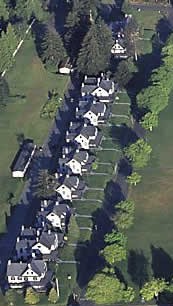
“Our family lived first in a duplex in the middle of Officers Row, later we moved to the large duplex next door to the Commanding Officer’s house.  The house was grand.  The rooms were big and we had a room for sewing  and a music room.  It was very Victorian . It was a beautiful place to live.  From our house you could look out and see snow capped mountains and Puget Sound.  It was breathtaking scenery, I had never seen anything like the scenery in the Northwest.  The house had a large dining room, because Army families had to entertain quite a lot.  There was a button in the middle of the floor that the hostess was supposed to push to summon the servants from the back in case they had to clear or whatever.  We had a butler’s pantry the size of most people’s kitchens. When my mother was planning a dinner, there was a certain protocol that had to be followed.  She would have to seat the officers and their wives according to rank.  She would have to get out the Army register to see who ranked who so she’d know where they should sit.  It was quite a formal occasion.  The servants were people from Port Townsend.  It was a very big house so Mother had help with the cleaning.  When she had a dinner party, she would have help with the cooking and someone to serve.  She had to show them how to serve from the left and all those formalities. It was pretty disruptive for the whole family.  We kids had to just disappear.  They’d send us to the post restaurant for supper.   As an officer’s child, there were certain rules to follow but I didn’t feel restrained at all.  We had Recall every evening at  five o’clock when they took the flag down.  It was a big ceremony and we always had to stop whatever we were doing and stand at attention.  Sunday afternoons were the time when the other officers came calling.  I wasn’t allowed to mingle socially with children of non-commissioned officers as long as we were on the post, but it didn’t matter in town. We had a post  movie theater. Officers’ families had to sit in a special place, we were segregated from the enlisted people.  On the post, we had a bowling alley, a roller skating rink, and tennis courts. Once a month we would go into Seattle and go shopping because there wasn’t much in the way of shopping in Port Townsend.  All the families would get on this mine sweeper and take a four hour boat ride to Seattle.  My girlfriend and I would go to the department stores and just have a wonderful time shopping. Then we’d spend four hours on the boat getting back to Fort Worden.  In the summer in nice weather, we would go down the long flight of stairs off the Commanding Officer’s Quarters to the beach.  We mostly sat on the beach because the water was too cold for swimming.  If we wanted to swim, we went to Discovery Bay.  We had a couple of friends from Port Townsend who had summer homes there. The water was about 62 degrees in Discovery Bay and we had a lot of fun.  To maintain the home, we had enlisted men from the post.  One was the furnace person. He’d come in and shovel the coal and take out the ashes.  Someone else would come around and cut the grass, and they would pick up the garbage.  We had a back porch with an ice box.  Someone would deliver the ice every day. The family wasn’t involved in any of the maintenance chores, we had all those little things taken care of by the Army.  My parents whole social life revolved around Fort Worden.  Because Port Townsend was such a small town in those days, and it was isolated—you had to take two ferries to get to Seattle—they were a long way from anything like a museum or concert or live theater.  I think they missed that sort of thing.  They did attend dances at the Officers Club on Saturday nights.    As a kid, I didn’t mind so much because I had my high school friends.  I had a good time and some good memories.”

Posted in Military | Tagged , , , , , , , , , , , , , , | Comments Off on Interview With Elinor Wright

Interview With Doug R. Wiley

From the interview with Doug R. Wiley of Port Townsend, WA conducted by John Clise at the Fort Worden History Center on July 31, 2003.  Mr. Wiley worked as a group life counselor at the Juvenile Diagnostic and Treatment Center from 1968 until it closed.  Here he talks about the dominant individual in social order of the cottage:

“They used to call the strong kid who took over the cottage ‘The Duke.’  He would run all the kids in the cottage, they’d look up to him. It was a real learning experience to see some of the situations that happened between The Duke and the different kids.  The Duke came in with power—his physical structure and his mind, his mind games. He would dominate, manipulate the kids in the cottage where they would look up to him and he would build up a following.  It was really something to see how much power that individual had in a group setting.  He could just snap his fingers and there might be turmoil with three or four kids because The Duke had set it up. He could manipulate different groups of kids to cause friction.  There were times when he could run the cottage where it would be just real calm and nice, a good shift to work so I wouldn’t have to deal with all the little problems that were caused by individual kids.                There were times when The Duke would try to push the counselor’s buttons as much as he could.  We had a kind of a quiet room, and when The Duke would get to the point of being really outspoken or whatever and you knew what was going on, you would put him there.  It was a small room with a door with a little window.  You could get him away from the group; if it got to the point where he was causing too much turmoil, you could call security.  They would lock him up, and the psychologist would talk to him.”

Posted in Juvenile Diagnostic & Treatment Center | Tagged , , , , , , | Comments Off on Interview With Doug R. Wiley

Interview With Frances M. Walls

From the interview with Frances M. Walls of Alexandria, VA conducted by phone from the Fort Worden History Center on May 25, 2004 by Sandra Lizut.  Mrs. Walls was the daughter of  Col. Frank M. Moose, who served in the U.S. Army Medical Corps from 1917 to 1947.  He and his family lived at Fort Worden from 1937 to 1941, while he was the post surgeon.  Here she describes some memories of life on Officers Row:

“At 5:00PM they had Recall and everybody had to stand at attention while they took the flag down.  My dad used to hurry home from the hospital so he could get in the front door before that time when the bugle blows and he would have to stand at attention.  He would manage to get in the house and we had to have dinner immediately.  He had a wonderful vegetable garden out behind the house next to the garages in a big vacant area.  Every night when he got home he’d quickly eat his supper and go out to the vegetable garden.  He preferred that to going to parties, as you know there were many necessary parties in the military.  He’d go because he had to, but he’d rather work in the garden.  He liked people, he was very nice, but he shied away from social activities.  My mother had her flower garden in front of his vegetable garden.”

The family had lived in Tientsin, China before being transferred to Fort Worden.  In answer to how her life had changed when she came to Fort Worden, Mrs. Walls replied:

“I got to ride in cars and laugh and get around and do things and be with other kids and go to movies.  And, oh, eat hot dogs.  It was just wonderful.  I didn’t know life could be so much fun.  Most of my social life had to do with school.  I really loved sports and I loved high school.  I had a deal with the football team that if they won, they could come out to my house and I would have banana cream pie.  So whenever they won, my mother would let me take over the kitchen and make banana cream pies for the football team.  They’d all sweep out to the house and park all around the hose.  They’d come into that big kitchen and eat banana cream pie. “

Posted in Military | Tagged , , , , , , , | Comments Off on Interview With Frances M. Walls

Interview With Anthony Tucholski

From the interview with Anthony Tucholski of Toledo, OH conducted by Rick Martinez at the Fort Worden History Center on May 12, 2002.   Mr. Tucholski served in the 248th Coast Artillery from June 1941 to September 1945.  He was stationed at Fort Worden, but spent most of his service time in the Aleutians as a mess sergeant.  Here he talks about cooking for the men who worked in the Alaska Communications system as linemen:

“The men would come in from putting up communications wires in 50-60 degrees below zero weather with the wind blowing 90 miles an hour and I had to have a meal ready, no matter what time it was.  I made lots of pot roast and mashed potatoes and gravy because they were frozen and wanted to eat.  When they would eat breakfast they would have scrambled eggs and piles of hotcakes.  They used to go out and hunt moose, black bear or porcupine.  They’d bring it in and we’d have it.  I wouldn’t skin it, that’s why I had KPs (kitchen police).  They were from Kentucky or Arkansas, where they eat fowl or wild game, so they didn’t mind it..  They’d pound a nail in there and ‘ssshhew’ it was gone.  They knew how to do it.  Then we’d cook the carcass.  The moose were beautiful.  We’d have roasts that thick and about that big around.  We’d have moose roast, moose stew, moose steak, black bear.  The porcupine was like chicken.  It all had a wild smell  to it.  We would use vinegar and whatever we could to kill the odor. We didn’t know which was worse—the stuff we were trying to kill it with or if we’d have just eaten it.  I had my filet mignon, maybe that’s why they called cooks ‘dog robbers.’  Once in a while we’d get sole from the big fishing boats off the Aleutians.  You’d lay them on their sides and they were about that high and that wide. We’d bring them in and cut them up, and the guys would eat filet of sole.  We’d deep fry halibut.  Some guys would stay there all night and eat them if they could.”

Posted in Military | Tagged , , , , , , , , , | Comments Off on Interview With Anthony Tucholski

Interview With Melvin L. Tompkins

From the interview with Melvin L. Tompkins of Apopka, FL conducted by Patience Rogge by phone on January 17, 2008.  Mr. Tompkins served in the U.S. Army during World War II. During his 18 months service at Fort Worden, he worked as a dental assistant.  Here he describes dentistry as practiced by the Army in the 1940’s:

                “In college I was preparing to be a dentist, so they wanted me in the dental unit.  I actually looked at the teeth of the whole regiment and did an assessment  of every one.  We had a record on the dental needs of the whole regiment.  I would look at their teeth and look for cavities and problems and put them on a file card.  The dental health of the regiment was pretty average, but we had a whole group from New York whose teeth needed a lot of work.  There was a lot of decay.  My job was to keep the records and I did all the mixing up of the amalgam and the materials the dentists used.  I would prepare the syringes for the deadening of the area where they were going to take out a tooth.  We took out quite a few third molars because at that age, a lot of young people have third molars crowding their other teeth.  We took out quite a few wisdom teeth and filled a lot of cavities, but there were some things that the Army would not do for the troops, like put braces on their teeth or do bridgework.   We used procaine hydrochloride for anesthesia and silver mercury for fillings.”

Posted in Military | Tagged , , | Comments Off on Interview With Melvin L. Tompkins