Interview With Floyd D. Kimball

From the interview with Floyd D. Kimball of Port Townsend, WA conducted by Hazel Hatfield on May 14, 2002 at the Fort Worden History Center.  Mr. Kimball served in the U.S. Coast Guard from 1950 to 1953 on active duty and from 1954 to 1960 as a reservist.  He had previously served in the Navy from 1945 to 1949.  Here he describes  an incident that occurred in his early days at the Point Wilson Light Station:

“I was on a midnight watch and it was about 4:30 in the morning, it was dark.  This light turns, the red flash got three flashes on it and it flashed every 20 seconds by rotation.  The light quit turning, and being inexperienced, I didn’t know what to do.  I didn’t report it to anybody.   I went up to unstop the light.  That was the first time I ever was up there.  I could turn it by hand but it wouldn’t go on its own.  So I turned the light for about an hour and a half by hand, guessing approximately how fast to turn it.  When it got daylight, I proceeded to tear the light apart.  It was brass, a pretty good sized light.  I found that it rolled around on ball bearings and the bearings had frozen.  They had no oil in them.  I looked through all the drawers and I found a bunch of ball bearings and I started replacing them.  In the meantime, it is getting to be around seven, seven-thirty and the keeper comes up looking for me, and I’m up in the light.  Here I am at the light, completely torn apart.  I thought he was going to fall over.  ‘What in the heck are you doing?’

I said, ‘The light quit.’

He said, ‘Well, what are you doing?’

I said, ‘I’m fixing it’

He said, ‘Do you know what you are doing?’

I said, ’Not really, but it’s pretty simple.  It’s electric and it runs on ball bearings, it rolls on ball bearings.  So, it can’t be that complicated.’

When I got done, I put it all back together and the light worked fine.”

The interviewer asked if he got any hero’s reward from the Coast Guard.

“No, no, no.  The keeper was probably too embarrassed to tell anybody, because it was actually lack of maintenance that the bearings got that way in the first place.  It shouldn’t have happened.”
Posted in Military | Tagged , , | Comments Off on Interview With Floyd D. Kimball

Interview With Todd Jensen

From the interview with Todd Jensen, head ranger at Fort Worden State Park, conducted on January 4, 2007 by Patience Rogge at the Fort Worden History Center.  Here he discusses wildlife seen in the park:

“There’s lots of it.  Quite a few people have encounters with the coyotes that live here in Fort Worden or are passing through.  Deer are also a common sight.  Sometimes you’ll see coyotes trotting across the parade ground in the middle of the day; normally, they’re best seen around dusk or sunrise.  But the deer can be seen just about any time of the day.  There is a pretty good population of deer the park, although you can go days without seeing them and then see a half dozen or more.  It seems that both the deer and the coyotes have transient as well as resident populations.  There are bald eagles just about every year that are wonderful to see, and lots of different kinds of ducks, blue herons, and kingfishers and cormorants offshore.  We have both the Douglas squirrel and the gray squirrel, and raccoons as well, but I don’t see as many raccoons in this park as in any of the other parks I’ve worked in.  We do get more complaints about raccoons stealing people’s food in the summertime because they’ll leave their food out in the campsites.  There have been confirmed sightings of cougars in the park, I haven’t actually seen them myself.  I haven’t seen any bobcats either.  One of the most interesting animals I’ve seen is in the marten family, weasels. I’ve seen them go down the storm drains or crossing the road.  The other very interesting animal we have here is the river otter.  You see them frequently in the warmer months of the summer.  You can see them hauled out on the float down by the Marine Science Center, crossing the road, going up the hill.  I’ve seen them going under the JFK building too.  They’re kind of neat to see and fun to watch.  They can make a real mess when they get into somebody’s boat, and it is a real challenge for us to keep the moorage float cleaned off.  You just have to hose it off or use buckets of sea water—they’re not your clean animal.”

Posted in Washington State Parks | Tagged , , , | Comments Off on Interview With Todd Jensen

Interview With William G. Himmert

From the interview with William G. Himert of Oregon, IL conducted by Oran DeBois by phone from the Fort Worden History Center on December 7, 2004. Mr. Himert served in the U.S. Army 369th Engineer Amphibious Support Regiment from 1950 to 1952, most of the time at Fort Worden. Here he describes his experience at Camp Desert Rock, NV during the atomic bomb tests:

“Went to Desert Rock and we were there for about three months in the spring of the year. I was there for seven A-bomb tests. I saw five of them. I was up forward for four of them. I hope I never have to see one of those again. The closest we ever got was about a mile, mile and a half.” Interviewer: Did they give you any protective gear?  “No, no. We were in slip trenches. One of the first jobs I had when I first went down there was to string wire for the PA system. The range people and the officers were running it. They were all in a big time reinforced concrete steel bunker back in the mountains about ten miles back. They were telling us, ‘You ain’t got nothing to worry about.’ It was quite an experience to go through that. As soon as they fired, we’d just drop down in the trenches til the shockwave would get over then we could get up again and watch it. Then they’d take us up and walk us through it and see what a mess it made.”

Posted in Military | Tagged , , , | Comments Off on Interview With William G. Himmert

Interview With Jack W. Hendry

From the interview with Jack W. Hendry of Bremerton, WA conducted by phone from the Fort Worden History Center on February 10, 2004 by Patience Rogge.  Mr. Hendry served in the U.S. Army 248th Coast Artillery G Battery and the 749th Military Police Battalion during World War II.  He had drawn the first draft number in Bremerton and was drafted on January 28, 1941. Here he describes his duties during his early days at Fort Worden:

“I was assigned to G Battery, which is a search light section of the 248th Coast Artillery.  My training part would be in the old balloon hangar, where we had search lights, power plants, sound locators, etc. We did our drill and we had to know all the parts of all the search lights and how to polish and clean it up and everything.  We’d be out as late as 10 o’clock or later because it didn’t get dark in the summertime.  We’d get quite a late start, but we still had to get up and report to duty at 5:45, regular Army time.”

In response to a question about the daily routine:

“We had to learn how to haul the search lights around and to learn about the planes they sent over for us to check on.  If we shined on them too long, they couldn’t see their instruments inside the plane.  On Fridays, we usually went on a hike in the area for five miles or more and we took all of our equipment.  Each outfit or battery would come marching in while we all stuck together.  We had a fellow who played the bagpipes and the snare drum and we’d always come back in marching like a bunch of Scotsmen.”

Other Fort Worden memories:

“They used to have machine gun practice on airplanes.  They flew in from Payne Field and they towed a target behind them.  It wasn’t very long after that they decided against it, because when they got back to Payne Field they found bullet holes in the tail section.”

“We had a Supply Sergeant.  Just after war was declared, he figured they didn’t have to keep any records because the war was on.  So he threw all his records out in the street.  The Captain came by and saw that and said, ‘Hey, pick all that stuff up and you keep your records up to date.”

“Before I left Fort Worden (He was shipped to San Luis Obispo to join the 749th) we used to feed the fellows in the field.  They had a 4 by 4 truck with fuel stoves in the back end and I used to cook pancakes.  When you went down the road, you’d start to pour them.  They’d be two inches wide on one end and a foot long.  Everybody got a warm breakfast and we also served a stew so they’d have a hot meal during the day.

I had some dental work done while at Fort Worden.  The dentist was at the hospital and he had a foot powered drill. His assistant ran the power for it by pumping pedals like he was on a bicycle.  The dentist drilled it all out and said, ‘You should have this in gold.’ So he gave me a gold foil filling, which he hammered in with a mallet.”

Posted in Military | Tagged , , , , , , , , , , , , , , , , | Comments Off on Interview With Jack W. Hendry

Interview With Clinton M. Hanks

From the interview with Clinton M. Hanks of St. Pete Beach, FL conducted by phone from the Fort Worden History Center on December 16, 2003 by Rick Martinez.  Colonel Hanks served in the US Army from 1943 to 1976, he was a veteran of World War II, Korea, and Viet Nam.  He was stationed at Fort Worden from 1946 to 1948 with the Second Engineers Special Brigade, later the 567th Engineer Boat and Shore Regiment.                Here he describes an incident that occurred while living at the Fort:

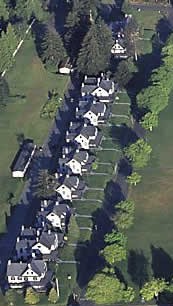
“We (he and his wife were married in the Fort Worden Chapel) lived in the old billets that were built around  1917.  They were so old they still had the electric wiring on the outside of the walls.  Anytime there was a fire on the base, the siren would sound off.  One day it sounded off, I said ‘Oh, boy, somebody has a fire,’ and the phone rang—it was the house I was living in.  The house had tall ceilings and one Sunday morning, I went into the kitchen and flipped the switch.  It was one of those turn things.  When I did, the wires started to catch on fire so I turned them off quick.  The engineers came and cut the wires and left them dangling.  They didn’t tape them or anything, and apparently I’d left the windows open in the kitchen.  The wind was blowing and the wires blew together and hardened, set the house on fire. When they redid it, they gave us black linoleum to put back in the kitchen.  Every time you walked across it, you left tracks.”

Posted in Military | Tagged , , , , , , , , | Comments Off on Interview With Clinton M. Hanks

Interview With LRH

From the interview with LRH of Sumner, WA conducted by phone by Patience Rogge on November 2, 2004 from the Fort Worden History Center.  LHR was a resident at the Fort Worden Juvenile Diagnostic and Treatment Center in 1959 when he was 17 years old.  Here he describes the rough justice the residents meted out to a snitch in their ranks and the consequences he faced because of it:

“We had one kid in the cottage that was what we referred to as a rat.  He got a couple of guys in trouble so we gave him a blanket party late at night.  Put a blanket over his head and we put soap in a sock and beat him with it.  When the screw came in trying to figure out who did it, everybody was lying back in his rack.  I was lying there and I knew the first one that moved was going to get rousted, and unfortunately I moved, so he grabbed me and threw me out and threw me down in the hole for three days.  I think I was on bread and water for three days.  I had it coming. We knew the consequences where you’re either going to get hit or you were going to be thrown in the hole, so we’d weigh what we were doing and if we did something we were well aware of what the trouble was going to be the price we had to pay for it.”

Posted in Juvenile Diagnostic & Treatment Center | Tagged , , , , | Comments Off on Interview With LRH

Interview with Harry L. Fridman

From the interview with Harry L. Fridman of Mayaguez, Puerto Rico conducted by Oran De Bois by phone from the Fort Worden History Center on March 12, 2004.  Mr. Fridman was stationed at Fort Townsend in 1942 as a diver in the Explosive Ordnance Disposal section of the U.S. Navy.  Here he relates an incident he witnessed at Fort Worden:

“They started a big expansion program for the Officers Club.  Because there was so much going on, they couldn’t find the powder monkey.  There was one guy who was very famous, a Swedish bird who was quite a drinker, nobody trusted him.  When he was mentioned to us, we said,  ‘No, we don’t even want this guy around the property.’  But anyway, the Commander of the Officers Club hired him.  We told him that he was going to have trouble.  The Swede was an old fashioned guy, he drilled with a hammer and a star drill.  He had a partner who was his helper.  There was a big boulder in one corner of the restaurant of the Officers Club, and he put his helper to work pounding down a hole in it so that they could blow the boulder.  Meanwhile, the manager of the club, who was very hospitable, invited the Swede in for a drink.  There was a big, hard stone to go through so it took a little bit longer, so the Swede got another drink, and another. Every time the Swede came out he said, ‘I think we’ll have to put a little more  charge in there.’  There were paperhangers on ladders putting up wallpaper in various parts of the club and electricians working there as well.  Finally, they were ready to blow.  The Swede lit the fuse and stood off, all was quiet and then KABOOM! Half of the Officers Club collapsed.  Paperhangers were falling down, all covered with paper and paste, the electricians were all fouled up.  There was a catastrophe all through.  Fortunately, no one was hurt.  The Commander came down and said, ’What the hell is going on here? Who did this?’  They all pointed at the Swede.  The Swede said, ’You hired me to blow this rock out and you don’t see no rock, do you?”

Posted in Military | Tagged , , , , , | Comments Off on Interview with Harry L. Fridman

Interview with Marvin C. Fowler

From the interview with Marvin C. Fowler of Quartzite, AZ conducted by Oran De Bois by phone from the Fort Worden History Center on March 11, 2004. Mr. Fowler served in the U.S. Navy from 1951 to 1971.  He was stationed at the Harbor Entrance Control Post at Fort Worden, where he worked on the signal tower at a triangulation station from 1956 to 1958.  Here he discusses the underwater detection gear that was used:

“We triangulated in the loops (magnetic loops connected to galvanometers on shore to indicate the passage of a submarine over each loop). They had hydrophones that we listened on and they actually had mines down there too.  We blew up the one that we put in, killed all kinds of fish—fisherman got rich out there on all the fish we killed.                We had the USS Elder and a Mine Hunting Craft. They had ships trying to sneak through on us.  They tried to sneak the first nuclear sub, the Nautilus, through on us and we caught it.”

In 1989, Mr. Fowler was called back to Fort Worden for Temporary Additional Duty:

“There was an ensign who took my place up there in the Harbor Defense Unit and he got put in prison.  He sold off all my charts and everything that was marked Secret.  I think he got put in Portsmouth Naval Prison, ME.  I got called off the USS Manatee to come back to see if I could remember where all this stuff was buried out there under that water after he disposed of all the charts.”

About his later career:

“I went to Comnavfor (Commander, Naval Forces) Japan for about four years.  I worked directly with the CIA there doing flotsam and jetsam.  We picked up all the floating stuff in the water, like Russian torpedoes and stuff.  We sent some back to Keyport to be tested.  The Russians said they could find our nuclear subs no matter where they were.  Well, we found their outfit so we could sabotage their signal and they couldn’t find it.  They thought they could but they couldn’t find us. I went from Japan to Mare Island, CA teaching on those river boats for Vietnam.  Then I went to an Icebreaker, the USS Titan in Staten Island, NY and then to the USS Fox, a guided missile frigate.”

####   ####

Posted in Military | Tagged , , , , , , , , , , , , , , , , , , , , | Comments Off on Interview with Marvin C. Fowler

Interview With Michael J. Fecho,jr.

From the interview with Michael J. Fecho, jr. of Port Hadlock, WA conducted by Eugene Walker at the Fort Worden History Center on  July 9, 2002.  Mr. Fecho was the son of Master Sergeant Michael J. Fecho, who served in the U.S. Army 14th Coast Artillery Regiment from 1927 to 1953.  Here he describes an unusual pet he had as a child growing up at Fort Worden:

“There was a deer, a fawn, I named her Bambi.  She roamed all over the fort.  I’d bring her into the house.  She loved cigarette butts.  Mom and Dad both smoked.  She’d come in and she’d just wipe the cigarette butts right out of the ash trays.  Of course, I had to put her back outside and make sure her little droppings went with her.”

He also tells of a memorable ride in a LCM from Point Hudson to the beach at Fort Worden:

“It got a little rough out there, which it can, in the summertime, storms come up here.  I just knew I was going to get seasick, I just had that feeling. I told the bosun who was driving the boat.  He said, ’Kid, you aren’t going to mess my boat up!’ The water started coming over the boat and he took me to the back of the boat and tied me to the flagstaff.  I thought I was going to drown.  I got sick, but the water just washed it away.  When I got off the boat down here at the beach, I was soaked.  I’ll never forget that GI who tied me to the flagstaff so I wouldn’t mess his boat up.”

Posted in Military | Tagged , , , , , , , | Comments Off on Interview With Michael J. Fecho,jr.

Interview With LKF

From the interview with LKF of Chattaroy, WA conducted by Patience Rogge by phone from the Fort Worden History Center on January 29, 2008.  LKF was a resident of the Fort Worden Juvenile Diagnostic and Treatment Center  in 1957-58, when he was 14 years old.  Here he describes life at the Center, where he lived in what is now the Coast Artillery Museum building:

“We would go upstairs and we’d play cards.  We had a pool table and a ping pong table.  I played a lot of ping pong, I was real good at it.  I learned how to play pool.  Then when we had dinner, breakfast and dinner, they’d take us downstairs and we would go into the kitchen and walk past with our trays and they’d give us our food and we’d sit down and eat.  When we were done, we’d dump our trays and go back upstairs.  They would bring us our lunch upstairs.  It was just cold sandwiches and stuff like that.  I remember kids smoking and they would take aspirins and grind them up and put them in cigarettes to get high.  I tried that one time, that made me sicker than s—.  There were always bullies and you had to stay away from them.  I never had any major bad experiences or anything like that.  I actually thought Fort Worden was a good place.  I made a home out of it.  I enjoyed it because I didn’t have a home life and I didn’t have association with other kids that were on the same level with me and I enjoyed that working there.  I vaguely remember that I got to go home for Christmas and I had to come back.  I rode a Greyhound bus all the way home (to Spokane).  They took me to Seattle and put me on the Greyhound.  When I came back I had to meet the station wagon that brought me back to the Fort.  My stay, looking back on it, was pretty pleasurable.”

Posted in Juvenile Diagnostic & Treatment Center | Tagged , , , | Comments Off on Interview With LKF