
Interview With Alan Hodge

From the interview with Alan Hodge of Clarkston, WA, conducted by Henry West at the Fort Worden History Center on September 18, 2003. Mr. Hodge worked at the Fort Worden Juvenile Diagnostic and Treatment Center from September 1959 to September 1971 as a Group Life Counselor. Here he discusses the treatment of juvenile offenders prior to the opening of the Fort Worden facility and how it changed:

“Before ’58, Washington juvenile treatment (was such that) every kid that got into trouble and was committed to a juvenile institution went to Green Hill, which was like a reformatory. They even had the old whipping post out on the parade grounds where, if kids got in trouble, they got put to the whipping post and given a few lashes in front of everybody, for everybody to see as a lesson. Then, the way I understand it, they hired Dr. Garrett Hines out of Kansas…He took charge of the juvenile corrections and he decided that punishment wasn’t the answer because what you were doing was handling the symptoms instead of looking for and treating the cause of the behavior. That’s when Fort Worden opened up as a diagnostic and treatment center. After that, every kid that was sent us through the courts to a state juvenile institution went directly to Fort Worden Diagnostic. There he spent six weeks in diagnostic and at the end of that six weeks, then it was decided whether he went to treatment or whether he went to Green Hill, which was still somewhat like a reformatory for the stronger, more delinquent kids. Eventually they opened up Echo Glen (which) was for the less toughies, the younger kids.”
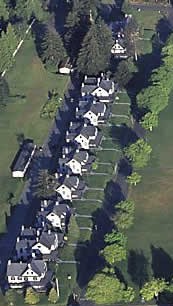
Posted in Juvenile Diagnostic & Treatment Center | Tagged , , , , | Comments Off on Interview With Alan Hodge

Interview With Charles J. Herzer

From the interview with Charles J. Herzer of Port Ludlow, WA conducted by Rick Martinez on July 2, 2002 at the Fort Worden History Center. Mr. Herzer was the son of Captain Charles J. Herzer, U.S. Army, who was stationed at Fort Worden during World War I. Here he discusses Army mules and a bit of Army humor:

“The Army mules at that time were much revered. In those days, the antiseptic that was used for cuts and minor surgery and so on was gentian violet. Whenever we went to the hospital they would paint one side of our behinds with a stylized US, which was how the mules were branded. When the mules were too old to work the Army would sell them, either for food or I don’t know what. They would brand the other side of the mule with the letters IC, which meant inspected and condemned so that the mule could not be sold back to the Army. Of course, we would always leave the hospital with somewhere painted on us the letters IC.”

Posted in Military | Tagged , , | Comments Off on Interview With Charles J. Herzer

Interview With Jack Hartt

From the interview with Jack Hartt on May 12, 2002 conducted by Mona Lou Stefflre for the Fort Worden Oral History Program. Mr. Hartt served as a Park Ranger at Fort Worden from 1989 to 1999. Here he describes his family’s life in Bldg. 352, a duplex built in the early 1900’s to house noncommissioned officers, a large two-story building:

“We had five children…There were times when people walking by wondered what was going on because they could hear screaming coming from inside because we’d have these great hide and go seek games or capture the flag games …We’d have a flag on each floor and then each side had one stairway. And you’d go up the stairs, down the stairs, chasing each other, in and out, through the doorways, making circles that way and up… It was just a riot, just a hoot. The kids just loved being there. Doing waterfalls, we’d start at the top of the stairs and then they’d ride on their butts to slide down the stairs all the way on pieces of cardboard…and just bounce all the way down, boom, boom, boom, boom down you hit the wall at the bottom and crash. Those kids just loved that 16 stair drop down. We had this huge backyard we turned into a baseball stadium, Frisbee field, and a lot of folks can remember camping in the upper campground and watching my family being a family.”

Posted in Washington State Parks | Tagged , , , , | Comments Off on Interview With Jack Hartt

Interview With George Earl

From the interview with George Earl of Port Townsend conducted by Carter Huth on December 23, 2004. Mr. Earl was a teacher at the Fort Worden Juvenile Diagnostic and Treatment Center. Mr. Earl died in 2006. Here he discusses what it was like to teach the Center’s residents:

“It was a learning curve that really opened my eyes. They don’t teach that kind of thing in a college teacher’s program. You learn an awful lot by experience. …As the name implies the school program was divided into two sections. There were those young folks who were here under a diagnostic program and they were very restricted, they were not allowed out without someone with them. They did have a class program and that’s where I started teaching. The treatment kids were assigned here after their diagnostic work for treatment. They lived in cottages, had pretty much free roam back and forth between their classrooms and the cottages and nobody was walking arm in arm with them… The diagnostic kids were really tightly controlled. We would see how they performed, reacted, under a classroom type situation with assignments, homework, things of that nature. Then we would sit with the other people who were involved, social workers, psychologists, cottage parents and the cottage board and collectively make the decision where this child ought to go next. It might be the treatment center here, it might even be back home under certain circumstances, or it might have been a tougher situation at Green Hill or the state detention. It was a very interesting situation. You don’t have any parents number one, you just got the kid. You got to dig through his files and reports to learn about him. Many of them came from very difficult situations and backgrounds, it was eye-opening. I thought I was a good judge of students but I got conned out of my shoes, I had to learn. (The teachers) learned a great deal more than we did in undergraduate and graduate school…I always thought the state should not have done away with it (the Center) but they had to make some budgetary changes…the evolution changed and so they did. Port Townsend was down again when the Diagnostic and Treatment Center left.”

Posted in Juvenile Diagnostic & Treatment Center | Tagged , , , , | Comments Off on Interview With George Earl

Interview With Rex Derr

From the interview with Rex Derr conducted by Wendy Los by phone from the Fort Worden History Center on December 28, 2004. Mr. Derr was the Director of Washington State Parks and Recreation Commission. He retired  from his post on November 30, 2010. Here he discusses the challenges he faced in his job in 2004:

“One of the things that we have seen with the State Park system over the last 20 years is a change in policy makers’ perceptions about the role of parks in government. Because, with growing populations, growing economies in states all across the nation (we’re not alone) the pressures to provide basic infrastructure for the economy and for social services have demanded more and more of public tax dollars. So park systems have been pushed to the side or pushed to the back of the line when public monies are distributed. What we’ve been trying to do is figure out how to make sure that park systems survive from one decade to the next as a service that citizens have said they’ve wanted but policy makers are having more and more difficulty providing, because of the competition for tax dollars. I guess for the last 20 years the resources—the public dollars—that we’ve had available to keep the park system together have constantly not declined, but have been constricted. We’ve had a couple of rough decades. What I’m committed to and I believe charged to do by my Parks Commission and the Legislature is to see if there’s not a different way to finance and operate and sustain the State Park System, which is now 92 years old. We know that we’re one of the largest, one of the most developed, one of the heaviest used five or six state park systems in the nation. We know the citizens love them. They want them, but keeping them open and safe and healthy is the extreme challenge for any administrator of a park system. Every park system, every state park system in the country, has been facing the same dilemma for the past 20 years. A couple of small park systems in New England have found some answers. They don’t depend on general tax dollars, they have a business deal to lease land to ski areas and leak the revenue from those leases to support their park systems. In Missouri, the voters stepped up and passed a dedicated tax that said conservation in parks is important to us, we want a certain percentage of all sales taxes to go to the State Parks.”

Posted in Washington State Parks | Tagged , , , , | Comments Off on Interview With Rex Derr

Interview With George W. Day

From the interview with George W. Day of Lummi Island, WA conducted by Mona Lou Stefflre on July 6, 2002 at the Fort Worden History Center. Mr. Day served in the US Army during World War II, he was stationed at Fort Worden in 1941:

“…I got to meet the Russians across the Elbe River at a town called Ludwiglust which had a Polish concentration camp (Woebbelin) in it. Full of dead bodies. We were set up (as) the government in town and searched it all out and made sure it was allright. …these people in town said they didn’t know the camp existed but you could smell it …Our orders were for them to dig up the square in the center of town and bury all these Polish people in it. Now, whether they did that, I don’t know because the Russians took over that part of the area and we pulled out. It made us a little disgusted because we had secured the place and the Russians came in, and the people were scared to death of the Ruskies. They waded across the Allbrute which is about four feet deep to get away from the Ruskies. They (the Russians) went in, they broke up furniture, they broke windows, they just ruined everything in town. Didn’t have any respect for the people there.”

“Another little story. We were on the banks of the Rhine River and…mortar fire took out our mess truck, which had all the supplies on it. We were out of food, we were 400 miles from the nearest distribution center. The troops went out and they got a wagon full of potatoes, cabbages—took them away from a farmer and we had potatoes. The beef were running around, the milk cows nobody had taken care of; and in my outfit were two kids from Iowa who still had their skinning knives with them. A heifer came in the area and they slit its throat and hung it on a tree and gutted it and we had meat was almost still quivering when it went into the field range (stove)….The orders were not to eat any of that stuff because it hadn’t been TB tested or anything. But we ate it because we wanted something to eat. After a couple of days, they got a truck back to us all loaded with supplies.”


Posted in Military | Tagged , , , , , , | Comments Off on Interview With George W. Day

Interview With Gordon Cramer

From the interview with Gordon Cramer of Seattle conducted at the Fort Worden History Center by Hazel Hatfield on May 11, 2002. Mr. Cramer served in the US Army, 369th Engineer Amphibious Support Regiment at Fort Worden during the Korean War era:

“…I was assigned to the 8055th MASH (Mobile Army Surgical Hospital). And I spent one full year with that MASH, an interesting experience. I came in as a medic, well they needed somebody in medical records; and the CO asked me if I could type, and I had seen military typists at work with two fingers and I figured, well, if that qualifies me, I could type…. About a month after I’d gotten there…the guy who was the sergeant was the NCO in charge killed his house boy and they didn’t want to court martial him so they shipped him out and we had a vacancy. They needed somebody to be the NCO and nobody wanted it. I told the captain if he’d get me my sergeant’s stripes I’d be glad to take that position. …I learned only last year that the fella who wrote ‘M*A*S*H*’ was at that hospital the whole time I was there. He was a doctor and I was an enlisted man, but I knew him. I had always wondered what outfit that television program or the movie had been written about because I never enjoyed it…it was too close to reality, just far too close to reality.”

Posted in Military | Tagged , , , | Comments Off on Interview With Gordon Cramer

Interview With Robert Costain

From the interview with Robert Costain of Port Townsend conducted by Patience Rogge at the Fort Worden History Center on August 14, 2008. Mr. Costain was a history teacher at the Fort Worden Juvenile Diagnostic and Treatment Center. Here Mr. Costain tells of one of his students who became the Rhododendron Festival Queen:

“At that time, the Rhododendron Festival was a big deal. Girls qualified for Queen by selling buttons for the festival. As sometimes happens, the people with a lot of money could buy more buttons. Of course that eliminated part of the female population, so the Festival Committee decided to change it…They hired some judges from Seattle and outside the area to be judges up here…Anyway, Mary won. It was unusual because the kids out here—the town put them down a notch or two…because they were thought of as bad kids. But a lot of them were not, they were just caught up in situations they couldn’t tolerate…a good portion of them were guilty of nothing other than being runaways committed by the court. Mary became Rhododendron Festival Queen and some of the local people were a little bit upset that she was chosen over the local girls…Everybody out here was happy because she was a good student and she played well in the band and was a pretty girl. She was being abused at home, ran away from home and got picked up and ended up here.”

Posted in Juvenile Diagnostic & Treatment Center | Tagged , , , , | Comments Off on Interview With Robert Costain

Interview With Beverly Collier

From the interview with Beverly Collier of Poulsbo, WA conducted by John Clise at the Fort Worden History Center on February 4, 2004. Here Ms. Collier discusses the filming of “An Officer and a Gentlemen” at Fort Worden while she worked in the Park Office Building:

“They (the movie crew) painted buildings, they put down carpets and everything had to be just the way they wanted it. One Sunday when I was working there…it was just one of the park attendants and myself…It was May. Those in charge of the filming came up (to the office) and they wanted all the Scotch broom cut on the bank down to the water because they didn’t want all that yellow in their film… because they were filming something on the water. You would never have dreamed the extent they went to, the minute things they had to have their way before it was filmed. But they re-carpeted buildings, they painted old buildings, they bought chairs by the dozen. Money was no object. What they wanted, they spent money for.”

Posted in Washington State Parks | Tagged , | Comments Off on Interview With Beverly Collier

Interview With Edward E. Claplanhoo

From the interview with Edward E. Claplanhoo of Neah Bay, WA conducted by Richard Martinez at the Fort Worden History Center on May 10, 2002. Mr. Claplanhoo, an elder of the Makah Nation, died on March 14, 2010. He had served in the U.S. Army 369th Engineer Amphibious Support Regiment from 1950 to 1952. Here he discusses being shipped to Thule, Greenland:

“I got inducted in the Army in November and February I was shipped to Coronado, California…and I took training there on boats. I came back to (Fort Worden) and they were forming A Company to go to Thule…then we shipped down to San Pedro and finished training there. After about eight weeks, they put us on a troop train and went to Norfolk. About the first of June, we got on Navy ships and headed for the North Pole. The ice didn’t break up early enough for us to get into Thule when we were scheduled to arrive, somewhere between the 15th of June and the 20th. We got up between Greenland and Canada in Baffin Bay and we drifted around Baffin Bay for almost a month before the ice flows inside the harbor broke up. We were able to go in the 10th of July and we ended up unloading 45 cargo ships in 30 days.”

Posted in Military | Tagged , , , , , , , , | Comments Off on Interview With Edward E. Claplanhoo